How to start collecting Pokémon cards
Pick a focus, buy from Pokémon Center or a store's own listing, sleeve and box your cards, and check condition, fakes and seals before every purchase.
By the Rip.fan Editorial Team.
Published 6 min read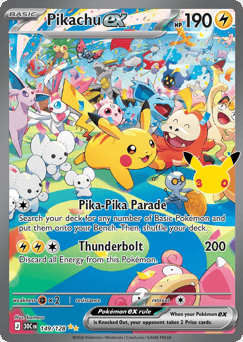
Start by choosing what to collect. English Pokémon sets run from 1999 to today, so a focus decides what you buy and what you skip. Pick one, such as a single set, one Pokémon or one era, and decide what finished looks like. Then buy at retail price from Pokémon Center or a store’s own listing, put every card you care about in a sleeve, and keep the box somewhere cool, dry and dark. Before each purchase, check the card’s set, number, condition and seal.
Step 1: what should you collect first?
Choose a focus you can describe in one sentence. It decides what you buy, what you skip and what complete means.
| Focus | What you collect | A real example | Read next |
|---|---|---|---|
| One set | Every card on one set’s list | Pitch Black has 120 cards: 84 in the numbered set and 36 above it | Rarity symbols |
| One Pokémon | A favorite across many sets | 30th Celebration alone has 30 Pikachu rares, numbered 023 to 052 | Card price lookup |
| One rarity tier | A single kind of card, such as illustration rares | Pitch Black has 11 illustration rares, and 30th Celebration has 18 | Card finishes |
| One era | The sets of a period, such as the first English sets | Base Set came out January 9, 1999, with 102 cards | Vintage sets |
| One artist | Cards by one illustrator | Each of the 30 Pikachu rares comes from a different illustrator | Reading a card |
| Japanese cards | Japanese printings of any of the above | A Japanese 30th CELEBRATION pack holds six foil cards | Japanese vs English |
Which focus suits how you like to buy?
Match the focus to the way you want to get cards, because each one leads to a different kind of purchase:
- You enjoy opening packs. A one-set focus fits, since every pack holds cards from a single set and each new card counts toward the list.
- You love one character. A one-Pokémon focus means buying singles, since a favorite’s cards sit across many sets. The card price lookup finds them by name.
- You collect for the art. An artist or a rarity tier such as illustration rares fits, and singles are the direct way to get a chosen card.
- You like the history. An era focus leads to older singles and graded cards. Our guides to 1st Edition and Shadowless cards and buying graded cards online cover the checks.
What does “complete” mean for a set?
Decide before you start, because a set has two sizes. The numbered set is the cards up to the printed total, such as 84 for Pitch Black. Everything above it in Pitch Black is an ultra rare, an illustration rare, a special illustration rare or the set’s one Mega hyper rare. Mega Evolution, from September 2025, has 188 cards, 132 of them in the numbered set and 56 above it. A goal of “the numbered set” is a very different project from “every card.”
Finish adds a third choice. Some commons, uncommons and rares also come in a parallel holo style, and Rip.fan’s lookup names the printing that each price is for. Decide whether one copy of each card is enough, or one in each finish.
Step 2: packs, sealed products or singles?
Each does a different job:
- A single is the exact card you want, in a condition you can judge before you pay. It is the direct route to finishing a list.
- Booster packs give a random mix from one set. Every pack holds at least one common, uncommon or rare card, and cards vary by pack.
- An Elite Trainer Box works as a starter kit. A Pitch Black Elite Trainer Box holds 9 packs, a full-art promo, 65 card sleeves, 40 Energy cards and a storage box with 6 dividers.
- A booster display holds 36 packs and nothing else. Our guide to Pokémon booster boxes explains which sets have one.
Our guide to Pokémon sealed products lists the pack count of every format. If you have opened a pile of packs already, our guide to bulk Pokémon cards covers sorting what is left.
Step 3: where can you buy at retail price?
Start with the maker and the big stores’ own listings:
- Pokémon Center. PokemonCenter.com is Pokémon’s official online shop. On Pokémon’s expansion pages, only the Pokémon Center Elite Trainer Box carries a “Shop at Pokémon Center” button; the other featured products carry “Find a Retailer.”
- A store’s own listing. Our guide to buying Pokémon cards at MSRP lists the retailers Pokémon names and shows how to spot an outside seller’s listing on a big store’s site, and how to read the return rules.
- Launch days. Our guides to card restocks at retail and Pokémon set release dates cover queues, purchase limits and what is coming.
For singles, a local shop or a card show lets you see the card first. Our guide to your first card show covers how to buy at a table, and buying raw cards online covers marketplace listings.
Step 4: how should you store the cards?
In layers, from the day you open them:
- A soft sleeve on every card you care about. Ultra PRO describes its sleeves as non-PVC polypropylene film that it calls archival-safe, and its penny sleeves measure 45 microns on each side.
- A toploader for your best cards. BCW’s standard 3x4 toploader takes cards up to 35pt thick, and BCW lists it as rigid PVC. Slide the card in already sleeved, so the polypropylene sleeve is what touches the card.
- A binder or a box for the rest. An Elite Trainer Box’s divided storage box is a fair first home for a set.
- A cool, dry, dark place. The Library of Congress advises keeping paper at room temperature or below, at about 35% relative humidity, with as little light as possible, and away from attics and basements.
Our guides to storing trading cards, card sizes and sleeves and organizing a collection go further. If you keep anything sealed, see storing sealed product.
Step 5: how do you check a card before you buy it?
Run the same five checks every time:
- Which card is it? Read the set code, the number and the rarity mark. The same Pokémon can appear several times in one set. Our guide to reading a Pokémon card shows where each detail sits.
- What condition is it in? A raw card is sold by its condition. Rip.fan’s price pages use NM for the best raw condition, LP, MP and HP for light, moderate and heavy wear, and DM for damaged. Our guide to card condition grades explains each step.
- Is it real? Our guide to spotting fake Pokémon cards covers checks that leave the card unharmed.
- Is the seal real? For packs and boxes, our guide to resealed Pokémon packs covers the wrap, seams and crimps.
- What does it sell for? Type a card’s name, set or number into Rip.fan’s card price lookup to see its NM market price and which printing that price covers. The price changes page lists the largest price moves between Rip.fan’s weekly checks, among cards priced at $5 or more at both checks. Our guide to looking up a Pokémon card’s value explains what those figures do not cover.
What comes after the first cards?
Keep a simple record of what you own: set, number, condition and where it is stored. The organizing guide above shows a format, and our guide to insuring a card collection explains why the same record helps there. When a card looks worth grading, our guide to whether a card is worth grading walks through the decision.
The Pokémon hub collects the rest of our Pokémon coverage, and Start here has reading paths through the site.
Frequently asked questions
What comes in a Pokémon booster pack?
10 cards from one set: 4 commons, 3 uncommons and 3 foils, at least one of them rare or higher. Sets before Scarlet & Violet guarantee only 1 reverse foil per pack.
What if a pack I opened has a creased or miscut card?
Pokémon exchanges whole packs, never single cards, and only when more than half of the cards have factory damage such as a crease. Write to its support within 10 business days of purchase, with the receipt, the code under the barcode and photos.
How can I tell if a cheap pack is fake?
Start with the price. Pokémon treats a pack priced far below its suggested retail price as a near-certain sign of a counterfeit, and it gets the most reports of fake sales from flea markets.
Which Pokémon has the most cards?
Pikachu, with 230 cards across 98 sets on Rip.fan's price pages. Charizard has 113 across 54 sets, and Unown 95 across 19.
How many English Pokémon sets are there?
Rip.fan's price pages list 198, counting subsets, promo series and special sets, from 1999 to 30th Celebration in September 2026. Together they hold 20,958 cards.