How to read a Pokémon card: what each detail means
What each printed detail on a Pokémon card tells a collector, from the set code and number to the illustrator credit, regulation mark and copyright line.
By the Rip.fan Editorial Team.
Published 6 min read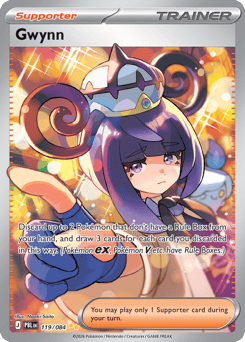
A Pokémon card answers a collector’s questions in fixed places. The small print says which card it is: the set code or symbol, the language, the card number over the set’s total, the rarity symbol, the illustrator’s name and, on newer cards, a one-letter regulation mark. The copyright line gives the year of the print run. The name, stage and HP figure identify the Pokémon, and the foil, the border and any stamp tell you which printing and which era you hold. Read in that order, those details tell you exactly which card to look up.
What does each part of a card tell a collector?
| Detail | What to look for | What it tells you |
|---|---|---|
| Set code or symbol | A short code near the card number; on vintage cards, a symbol at the bottom right of the picture frame | Which expansion the card belongs to |
| Language mark | Two letters printed with the set code, such as EN | The print language |
| Card number | Two numbers with a slash, near a bottom corner | Which card in the set, and whether it sits above the main list |
| Rarity symbol | A small mark beside the card number | The card’s tier in its set |
| Regulation mark | One letter at the bottom of the card | That the card dates from the Sword & Shield Series or later |
| Illustrator credit | “Illus.” and a name | Who drew the card |
| Copyright line | The rights holders’ names and a year | The rights holders and the year of the print run |
| Name and stage | The name, with Basic, Stage 1 or Stage 2 | Which Pokémon it is, and its stage |
| Pokédex data bar | A number, a category, a height and a weight | Which species the card shows |
How do you read the small print?
Start with the set. English cards from the Scarlet & Violet era on print a short set code, such as SCR for Stellar Crown, in place of the older picture symbol, with a small EN for English. Older cards carry a symbol, which sits at the bottom right of the picture frame on vintage cards. Base Set cards have no symbol at all.
Next comes the card number, such as 115/142: the card’s own number, then the set’s printed total. A card numbered higher than the printed total is one of the set’s secret rares. Our guide to Pokémon rarity symbols explains each mark that sits beside it, and our guide to promo cards covers the black star with the word PROMO that promos print instead.
What does the color of the code box mean?
On Scarlet & Violet era cards, the box around the set code is a clue to the printing. In an article dated March 30, 2023, Pokémon said the code normally sits in a black box with white text, and that on parallel foil cards it is a white box with black text. That helps when you can’t tell from the shine alone. CGC describes the two foil types: on a holo only the picture box shines, and on a reverse holo the foil covers everything except the picture box. Our guide to card finishes covers the rest.
What is the regulation mark?
It’s the single letter at the bottom of the card. Pokémon announced on April 21, 2021 that cards from the Sword & Shield Series on carry the letter, and that cards from one expansion don’t always share the same one. The first marks date to 2020, starting with D. For a collector, the letter is a quick era check: a card with a mark dates from 2020 or later. Read it with the other clues below.
Who drew the card?
Each Pokémon card names its artist in small print, after the abbreviation “Illus.” A Stellar Crown Noctowl, for example, reads “Illus. matazo.” Rip.fan’s card price pages list an Illustrator line where the data has one, so you can check the credit on the card in your hand against it.
What does the copyright line tell you?
The last line of small print names the rights holders. It lists three companies, Nintendo among them, and also carries the year of the print run. The year matters most on early cards. A late print run of Base Set, released in the UK in 2000, changed its copyright date to 1999-2000 and often looks lighter than earlier runs. Our guide to 1st Edition and Shadowless cards uses the same line to tell the Base Set prints apart.
What does the top half of the card show?
The name comes first, with its suffix. CGC traces those suffixes through the card’s history, which makes them a rough guide to era:
| Suffix | Set where CGC says it began |
|---|---|
| ex (lower case) | EX Ruby & Sapphire, and again in Scarlet & Violet |
| VSTAR | Brilliant Stars |
| V | Sword & Shield |
| GX | Sun & Moon |
| EX (capitals) | Black & White: Next Destinies |
| LV.X | Diamond & Pearl |
A stage badge shows whether the card is Basic, Stage 1 or Stage 2, and a small line names the Pokémon it evolves from. The card also prints a type symbol and an HP figure.
A data bar gives the National Pokédex number, the species category, height and weight. Pokémon ex and other special cards drop the flavor text, a short Pokédex-style line, to make room for a text box of their own.
How do you tell a card’s era at a glance?
Put the clues together, newest first:
- Gray border. Pokémon’s 2023 article said the Scarlet & Violet Series would move English cards from yellow borders to the gray border used in Japan. A gray border on an English card suggests that series or a later one.
- Set code letters in place of a symbol. Scarlet & Violet era on.
- A regulation mark. Sword & Shield Series on, from 2020.
- The name suffix. Use the table above.
- The label on the card text. Vintage cards print Pokémon Power, and Ability has been the label since 2011.
- A 1st Edition stamp. CGC says English cards carried it on first print runs from Base Set through Neo Destiny, about three years, and that Base Set 2 had none.
- The copyright year. It gives the print run’s year.
How do Trainer and Energy cards differ?
Trainer and Energy cards share the bottom line of small print with Pokémon cards (set code, number, rarity and regulation mark), but carry text in the middle where a Pokémon card prints its stats. Energy cards changed from Scarlet & Violet on: each Basic Energy card now has a set code at its bottom left, the Energy symbol repeats at the bottom right, and a tag at the top reads Basic Energy or Special Energy.
Which details decide the price?
Four of them: the set, the number, the printing and the condition. The stage, the type and the card text help you confirm the card, but they don’t change which price applies. CGC adds two more things to watch for: stamps on tournament promos, which name the tournament and year, and error cards with odd markings or cut-off art.
With the set, number and printing in hand, our guide to looking up a Pokémon card’s value walks through the card price lookup, and our guide to spotting fake Pokémon cards uses many of the same details as checks. For the size of the card and the sleeves that fit it, see our guide to Pokémon card sizes and sleeves.
Frequently asked questions
Who drew Base Set Charizard?
Mitsuhiro Arita, the artist behind Base Set Rattata and Skyridge Celebi too. Rip.fan's card pages list 736 of his cards, across 135 sets.
Why does the gray border shine on some cards?
On rare cards, the gray border lets the foil show through. Double rare cards keep a foil border with a star-like sheen, and Tera Pokémon ex add a textured foil across the whole card.
What is the pattern on a Scarlet & Violet reverse holo?
A foil pattern that echoes the tile designs of Paldea, the region of the Scarlet & Violet Series. As on older parallel foil cards, it surrounds the artwork rather than covering it.