Vintage Pokémon sets explained, from Base Set to Skyridge
The 16 English Pokémon sets Wizards of the Coast printed from 1999 to 2003, in order, with each set's date, card count and the marks that identify its cards.
By the Rip.fan Editorial Team.
Published 6 min read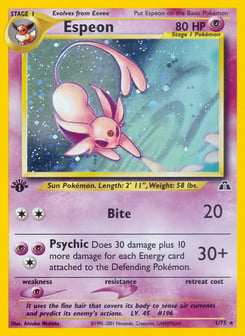
Vintage Pokémon sets are the 16 English sets Wizards of the Coast printed between Base Set, released January 9, 1999, and Skyridge, released May 12, 2003. CGC, the grading company, dates Wizards’ run as the publisher of the English cards to 1999 through 2003. The quickest way to place a card from that era in its set is the set symbol, which sits at the bottom right of the picture frame. Base Set is the one set with no symbol.
Which sets did Wizards of the Coast print?
Counts include cards numbered above the printed total.
| Set | English release | Cards | What marks it |
|---|---|---|---|
| Base Set | January 9, 1999 | 102 | No set symbol; several print runs |
| Jungle | June 16, 1999 | 64 | Vileplume’s flower; rares in holo and non-holo versions |
| Fossil | October 10, 1999 | 62 | The same 15 Pokémon as holos (1 to 15) and non-holos (16 to 30); no Energy cards |
| Base Set 2 | February 24, 2000 | 130 | A Poké Ball with a 2; reprints from Base Set and Jungle; no 1st Edition |
| Team Rocket | April 24, 2000 | 83 | The Team Rocket R; Dark Pokémon; Dark Raichu at 83/82 |
| Gym Heroes | August 14, 2000 | 132 | An amphitheater with a black stage; Gym Leaders’ own Pokémon |
| Gym Challenge | October 16, 2000 | 132 | The Gym Heroes symbol with colors swapped |
| Neo Genesis | December 16, 2000 | 111 | Two stars; the first Johto Pokémon |
| Neo Discovery | June 1, 2001 | 75 | A temple; the first Unown cards |
| Southern Islands | 2001 | 18 | A palm tree; sold in a binder with six postcards |
| Neo Revelation | September 21, 2001 | 66 | The first Shining Pokémon |
| Neo Destiny | February 28, 2002 | 113 | A dark sparkle over a light one; Light and Dark Pokémon |
| Legendary Collection | May 24, 2002 | 110 | A medal; reprints, each also as a reverse holo |
| Expedition Base Set | September 15, 2002 | 165 | A Poké Ball drawn as a lowercase e; the first Supporter cards |
| Aquapolis | January 15, 2003 | 182 or 186 | A skyline inside a water drop; the first Crystal Type cards |
| Skyridge | May 12, 2003 | 182 | Two mountains, one with a halo; the last Wizards set |
Wizards also issued promo cards in a series of their own, the Wizards Black Star Promos, marked with a black star instead of a set symbol. Our guide to Pokémon promo cards covers them.
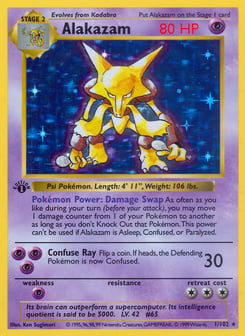
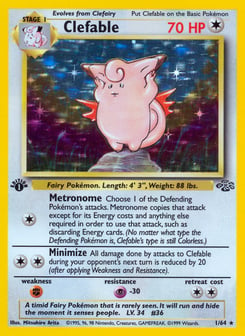
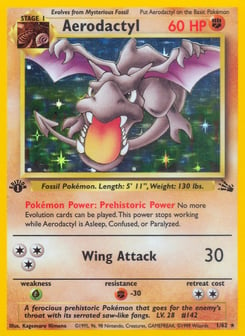
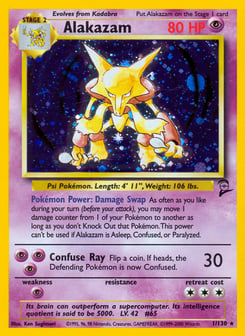
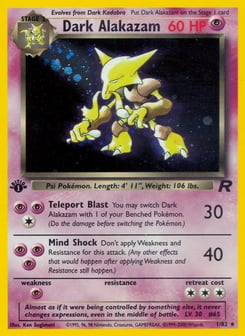
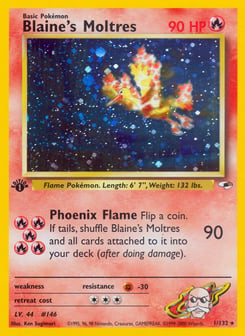
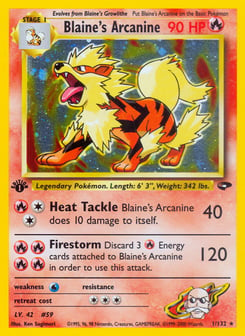
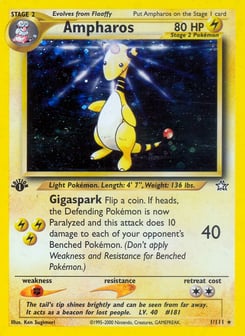
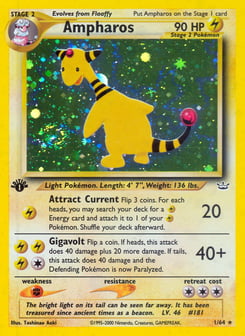
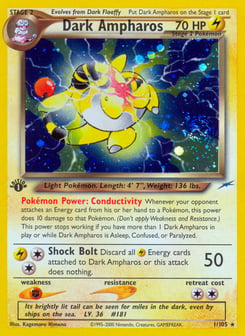
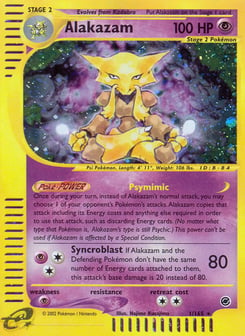
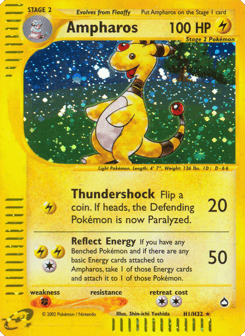
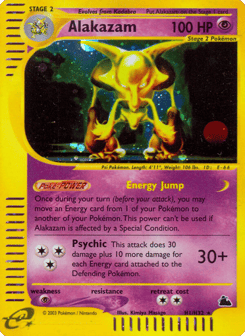
Images from Scrydex.
How do you tell which set a card is from?
Start with the symbol. It sits in the lower right corner of the picture frame on vintage cards, and near the card number on modern ones. A card with no symbol is usually from Base Set, but some Jungle holos were printed without their symbol, so check that the number’s total is 102. A Poké Ball with a 2 through it is Base Set 2, a set made entirely of reprints.
Next, read the card number. Vintage numbers are written over the set’s total, as in 4/102, so the second figure narrows the set before you even find the symbol. Gym Heroes and Gym Challenge both total 132, so for those two the symbol decides it.
Last, look on the left side, below the picture, for the black 1st Edition stamp. On Fossil cards it sits opposite the set symbol. The stamp marked first print runs from Base Set through Neo Destiny, and Base Set 2 had none. Our guide to 1st Edition and Shadowless cards covers how to read it, and the Base Set prints, in detail.
What changed from one era to the next?
The Base era, 1999 to 2000
Base Set came first, and it was printed in several runs, among them 1st Edition, Shadowless and Unlimited. Jungle began printing its rare Pokémon in both holo and non-holo versions, and Fossil did the same with its 15 rare Pokémon. Team Rocket added Dark Pokémon, which are drawn with a brown and black picture frame. It also held the first holofoil Trainer and Energy cards.
The Gym era, 2000
Gym Heroes introduced Trainer’s Pokémon, cards for the Gym Leaders’ own Pokémon, such as Misty’s Seadra. The set also dropped the flavor text to make room for the Gym Leader’s portrait and badge. Gym Challenge continued with Sabrina, Koga, Blaine and Giovanni.
The Neo era, 2000 to 2002
Neo Genesis brought in the Johto Pokémon. CGC says the set also updated the card layout, with new looks for the evolution box, the stage display and the weakness and resistance symbols, and that it introduced Darkness and Metal types, Baby Pokémon and attachable Pokémon Tools. Neo Revelation added Shining Pokémon, and Neo Destiny closed the era with Light and Dark versions of familiar Pokémon. Neo Destiny was also the last English set with a 1st Edition print.
The last Wizards sets, 2002 to 2003
Legendary Collection reprinted cards from Base Set, Jungle, Fossil and Team Rocket, and was printed in Unlimited only. Every card in it also came as a reverse holo, with foil over the whole card except the picture. These were the first reverse holos. Expedition Base Set, Aquapolis and Skyridge followed, each built around dot codes for the e-Reader. Expedition was the first set with Supporter cards, and Aquapolis the first with Crystal Type cards.
Which vintage cards are numbered past the set total?
A number higher than the total marks a card outside the main list, the idea collectors call a secret rare. Team Rocket’s Dark Raichu, numbered 83/82, was the first. Neo Destiny added 8 Shining cards above its 105. Skyridge numbers its first 32 cards H1 to H32 before the main list, which runs to 144, and its 6 Crystal Type cards continue to 150/144.
Is it an original or a reprint?
Several later sets reuse vintage art, so check the symbol and number before you trust the picture.
- Base Set 2 and Legendary Collection. Both reprint early cards with their own symbols and numbers. Base Set 2 holds 94 Base Set cards and 36 from Jungle.
- Celebrations. Its Base Set reprints show a 25th Anniversary logo.
- 30th Celebration. Its packs can hold classic cards, including Base Set Charizard, with a new foil treatment.
The original Base Set card has no symbol at all. Rip.fan’s Pokémon card price pages list each of the 16 sets above (Base Set appears there as Base), plus the Celebrations and 30th Celebration Classic Collections, as separate sets. So a reprint and its original do not share a price page.
How do you look up a vintage card?
Find the set and number first, then the printing. On Rip.fan, each vintage set page lists every card by number. Card pages give a separate price for each printing the data covers, such as 1st Edition and Unlimited. The card price lookup finds a card by name.
Condition moves a vintage price too. Our guide to card condition grades explains the scale, and how to spot fake Pokémon cards covers the checks to run before you buy. For what the finish on a holo or reverse holo means, see Pokémon card finishes. The Pokémon hub collects the rest of our coverage.
Frequently asked questions
What was the last Wizards of the Coast Pokémon set?
Skyridge. EX Ruby and Sapphire was the first set published after Wizards, by Pokémon USA.
Which Wizards era card has the highest price?
Skyridge Umbreon (H30/H32), which had a Near Mint market price of $4,999.99 on October 21, 2026, ahead of Skyridge Celebi (145/144) at $3,999.99 and Neo Destiny Shining Charizard (107/105) at $3,998.99.
Why does Neo Genesis have two cards for each Johto starter?
The set gave every Johto starter and each of their evolutions two cards with different artwork. Its name, Greek for New Beginning, marked the first set of the Neo Series.
How many Base Set cards has CGC graded?
As of May 31, 2022, CGC had graded almost 23,000 1st Edition Base Set cards and nearly 68,000 Unlimited ones. Only 252 of the 1st Edition cards were Charizards.