Your first card show: how to buy, sell and trade
How a card show works, what to bring, and the three checks to make at every table: the card's condition, its recent sold price and the slab's cert number.
By the Rip.fan Editorial Team.
Published 6 min read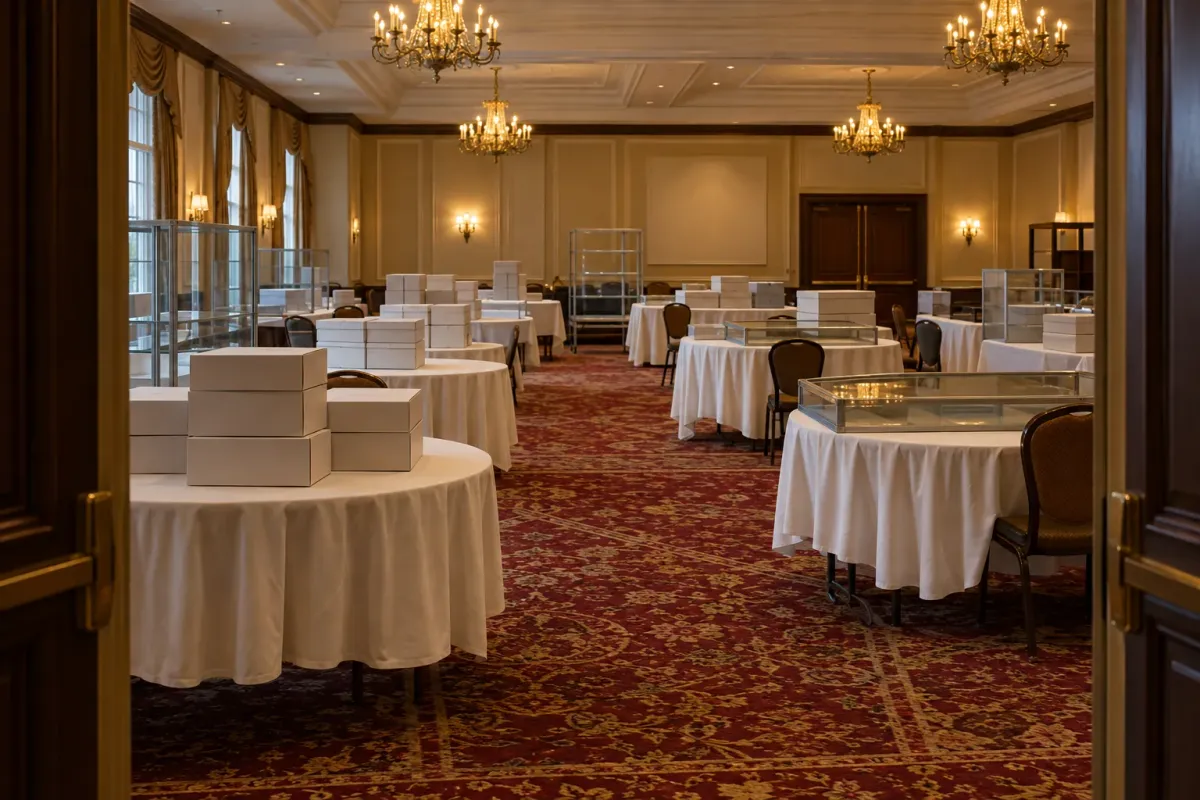
A card show is an in-person event where dealers and collectors buy, sell and trade cards. Go in with a want list, supplies to protect what you buy, and a charged phone. Then make three checks at every table before you agree on a price: the card’s condition, what the same card has recently sold for, and, on a graded card, its cert number.
What happens at a card show?
Dealers sell from their tables, and collectors walk the aisles, ask to see cards, and buy, sell or trade on the spot. The 2026 National Sports Collectors Convention, at the Donald E. Stephens Convention Center in Rosemont, Illinois, listed more than 600 dealers on 500,000 square feet of floor.
Large shows can also bring grading companies. The 2026 National listed on-site grading and encapsulation from CGC for sports, non-sports and trading cards, plus drop-offs for its regular service, and said SGC would be collecting submissions for its take-home service. If you plan to grade what you buy, Rip.fan’s grading cost calculator takes a card’s declared value and shows each company’s cheapest and fastest service level, with the day each price was read.
A show is a shared space, and the big ones publish rules for it. At the National, harassing photography or recording is among the behavior the organizers do not accept, and visitors are asked to report any problem to an organizer or at the registration desk in the lobby. Ask a dealer before you photograph their case.
How does a big show’s week run?
The National shows the pattern. The 2026 show ran for five days, from July 29 to August 2. It opened with a Wednesday preview from 2 pm to 8 pm, with every exhibitor booth open, then ran from 10 am to 6 pm Thursday to Saturday and from 10 am to 4 pm on Sunday. Early-entry badges let holders in 60 minutes before general admission each day, and the schedule added a Trade Night from 6 pm to 11 pm on Thursday, Friday and Saturday.
A single-day general admission ticket cost $30 on site, or $25 bought online by June 30, and covered any one day, the Wednesday preview included. Veterans and active or retired military members could get in free with a qualifying photo ID.
The 47th National returns to the same convention center from July 28 to August 1, 2027. Huntington Place in Detroit follows on August 2 to 6, 2028, and Rosemont again on July 25 to 29, 2029.
What should you bring?
- A charged phone. You will use it for price checks and for cert checks while you stand at the table.
- Sleeves and toploaders, and a bag you can keep close, for what you buy, so a new card doesn’t ride home loose. Our guide to storing trading cards covers sizes.
- Some cash in small bills, and a question for each dealer about how they take payment, asked before you agree on a price. The National had 15 ATMs throughout the show.
- A want list. For each card, note the set, the card number and the printing, so you can match it at a table without guessing.
- Your own cards, sorted, if you plan to sell or trade. Bring a sleeved selection, with your notes on recent sold prices, and leave the rest of the collection at home.
What should you check at every table?
1. What condition is it in?
A condition label on a raw card is the dealer’s opinion, so make your own check before you agree on a price. Ask before you pick a card up, hold it by the edges, and don’t take it out of a toploader unless the dealer says you can. Then look for the flaws that cost the most under TCGplayer’s rules:
- A crease. Tilt the card under the light. Any crease caps a raw card at Moderately Played.
- Whitening and wear. Check all four corners and edges. Edge wear up to 20mm long can still be Near Mint under TCGplayer’s rules, but a longer run of it cannot, and neither can any worn patch that shows bare card stock.
- Centering. Compare the borders on opposite sides. Past 70/30, TCGplayer counts the card as Damaged.
- Marks or writing. A signature, stamp or ink that wasn’t printed on the card makes it Damaged.
Our guide to card condition has the full scale, from Near Mint to Damaged.
2. What has it sold for?
A price sticker is an asking price, not a sale, so look up recent sales of the same card in the same condition or grade before you start a deal.
- Pokémon cards. Rip.fan’s card pages give a dated NM market price for each printing of an English Pokémon card, plus a price for each raw condition. The card price lookup finds a card by name, set or number.
- Cards sold on TCGplayer. Its Market Price is compiled from recent sales on its own site. Set the printing and condition filters on the product page first, because its price points follow them.
- Skip the Listed Median. TCGplayer builds it from asking prices only, and on older cards with few copies for sale it can sit far from what buyers actually pay.
Our guide on how to find what a card sold for sets out the full method, eBay’s sold listings included, and shows how to drop sales that don’t match.
3. Does the cert number check out?
A slab’s label carries a cert number, which you can look up on the grading company’s own site while you stand at the table.
CGC shows how this works. Its label carries the card’s description, its grade, a certification number and a QR code. CGC photographs every card after sealing it in the holder, and its Verify CGC Certification tool shows those photos at any hour. So check more than the number: compare the card in the slab with CGC’s photo, and the label in your hand with the record on screen. If anything differs, or no record comes up, don’t buy until you know why. Our guide to whether rip site cards are real and our guide to spotting fake Pokémon cards cover more warning signs, and the glossary explains a counterfeit card.
How do you sell or trade at a show?
To sell, show a dealer your cards and ask what they would pay. The 2026 National billed its 600 vendors as seeking large and small collections. Compare any offer with the recent sold prices you looked up before you accept. Describe the condition of each card as accurately as you can, using the scale in our guide to card condition.
To trade, agree on a figure for each side from recent sold prices, and ignore the stickers. Then run the same three checks on what you receive: condition, sold price and, for slabs, the cert number.
What should you do after the show?
- Sleeve and store everything you bought the same day.
- Look up the cert number of any slab you didn’t check at the table.
- Note each purchase with its date, the price you agreed on and, for slabs, the cert number.
- Check the prices again a few days later, with the date, so your records stay current.
Big purchases don’t always have to ride home with you. The 2026 National had a shipping and printing booth on the show floor for dealers, companies and visitors alike. Our guide to shipping a graded card yourself covers how to pack a slab and insure it in transit.
For more on Pokémon prices, start at the Pokémon hub; for sports cards, the sports cards hub.
Frequently asked questions
How much is parking at The National?
At the 2026 National, parking at the Donald E. Stephens Convention Center was typically $15, though the fee varies by event, and cash or credit was accepted. The lots are on site, gated and lit.
Is there Wi-Fi for price checks at The National?
Yes. Wireless internet covers the convention center, and free Wi-Fi for light use is offered in the lobby, the pavilion and the lower-level concourse meeting area.
Can I bring food and drinks into The National?
No. Outside food and drinks are not allowed at the Donald E. Stephens Convention Center, where food and drinks come only from its in-house partner.
What if I lose something at The National?
The convention center keeps lost items for 30 days and may dispose of them after that. Call 847-692-6415 with a detailed description or photos.