Best places to sell PSA graded Pokémon cards
Six places to sell a PSA graded Pokémon card, ranked: rip site trade-ins, Whatnot, eBay, TCGplayer, auction houses and shops, with fees and payment times.
By the Rip.fan Editorial Team.
Published 10 min read
A PSA slab of a Pokémon card sells fastest where it already sits. If it came from a pack on a rip site and is still in that site’s vault, the site’s instant trade-in offer or its own marketplace sells it with nothing to pack or post. A slab in your hand goes to Whatnot, eBay or TCGplayer, which left 84% to 89% of a $100 or $500 sale after fees in Rip.fan’s worked examples below. An auction house suits the dearest slabs, and a shop or show pays the same day at a price it sets. The list is ranked by how much of a sale reaches you, how soon, and what stands in the way.
The six places at a glance
| Place | What it takes | When the money reaches you |
|---|---|---|
| 1. The rip site holding the slab | Its offer is a share of its own value for the card, 85% to 100% on the sites below, before any fee | Your account balance, at once, on TiltRips and Gotya |
| 2. Whatnot | 8% of the price up to $1,500 and nothing on the rest for now, plus 2.9% of the order total and $0.30 | Within 4 hours of confirmed delivery, then 1 to 2 business days to your bank |
| 3. eBay | 13.25% of the order total up to $7,500 and 2.35% above it, plus $0.40 an order | A payment starts every day, then takes 1 to 3 business days to clear |
| 4. TCGplayer | 10.75% of the card (at most $75) and of the shipping, plus 2.5% of the order total and $0.30 | Payments start Mondays and Thursdays, then about 4 business days by direct deposit |
| 5. A shop, a show or a buyer you know | No fee at a shop or show, and 2.99% on a PayPal goods and services payment | On the spot at a shop or show |
Goldin is the auction house to know: its seller commission is agreed with its sales team, and buyers pay 22%.
1. The rip site that already holds your slab
Best for: a PSA slab that came from a pack on a rip site and still sits in that site’s vault.
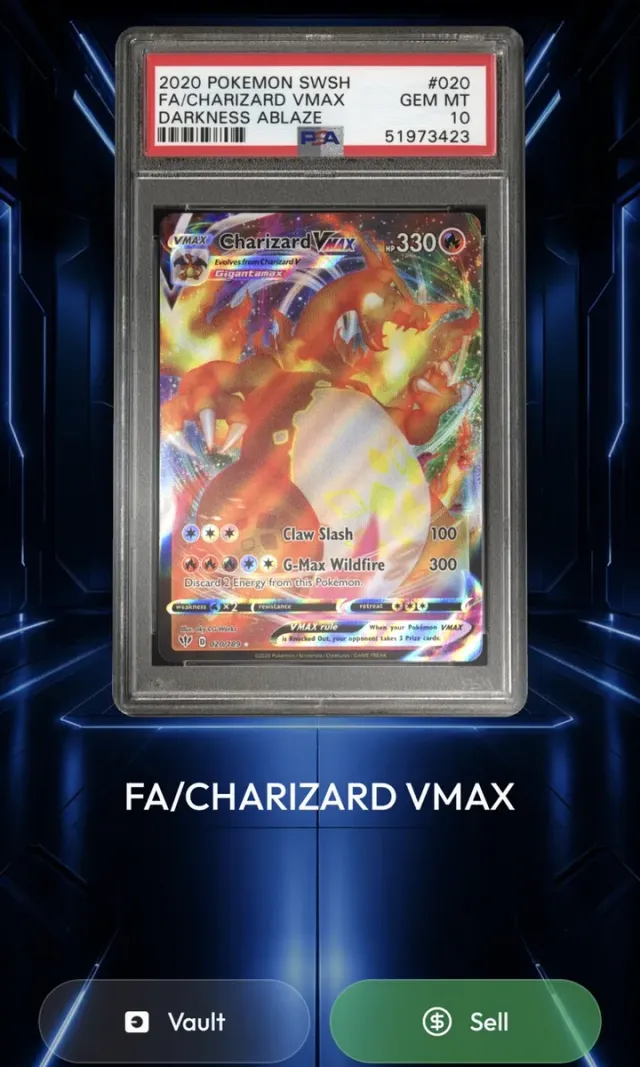
Rip sites sell packs of real cards, many of them graded, and keep each card in a vault until you ship it home or sell it. Selling a slab where it sits is the quickest route on this list. The card never moves, so there is no box to pack, no postage, no wait for delivery and no buyer to chase. Each site below makes an instant trade-in offer on the cards from its packs, and several run a marketplace as well. Each is in our ranking of rip sites, which scores trade-in terms as one of its eight criteria.
| Site | Instant trade-in offer | Other ways to sell or move the card |
|---|---|---|
| Rips by Triumph | The card’s full value as set when you bought the pack, held for at least seven days | Ship it to a US address for a flat $6, with tracking |
| Phygitals | A share printed on the pack page before you pay, 85% to 100% of the card’s listed value on the packs in our review | Keep it in the vault or ship it home |
| Collector Crypt | 85%, 90% or 93% of the card’s listed value, depending on the pack | A busy marketplace of graded cards |
| Glyde | 85% to 93% of the card’s value, shown before you open the pack and higher on its dearer packs | Collector Crypt holds the cards and ships one when you redeem it |
| TiltRips | 90% of live market value, with no fee and no deadline | List it on its marketplace, which shows what single cards just sold for, or ship it home |
| Shiny | 94.39% of market value less a 2% fee for the first 24 hours, then 85% less 2% until day 7 | Its own marketplace, with a 4% seller fee, or redeem it for worldwide shipping with tracking and insurance |
| Gotya | 90% of market value on a graded card, open for the time shown with the offer | List it on its marketplace, with no seller fee |
Every card in Shiny’s packs is PSA graded. TiltRips and Gotya credit an accepted offer to your account balance at once, and both let you withdraw that balance. On Rips by Triumph, a card left unshipped for seven days is traded in at its set value automatically, so decide within the week.
Collector Crypt’s vault also takes graded cards you send in yourself, graded cards only, so a PSA slab bought elsewhere can be stored there too.
2. Whatnot
Best for: slabs under about $900, and selling to buyers in a live show.
Whatnot charges its commission on the card’s price alone, never on the shipping or the tax, which is why it left the most on the cheaper slabs in the worked examples below. Its 0% rate on the top part of a dear sale is a limited-time promotion that began on January 14, 2026. It covers trading card games, Pokémon included, and Whatnot can end it at any time.
The money is quick. For a US seller it is ready within four hours of confirmed delivery, and sellers who qualify for early release can have it when they make the shipping label. Our guide to selling on Whatnot covers the application, the shows and the shipping rules.
3. eBay
Best for: a slab you want checked by eBay’s authenticator before the buyer gets it, and a slab already stored with PSA.
eBay took the largest share of the three marketplaces at every price in the worked examples, because its fee applies to the shipping and the sales tax as well as the card. What it adds is a check. Slabs that sell above its line go through its Authenticity Guarantee: you send the slab, insured, to an authentication facility at your own cost, and eBay pays for the check and for tracked shipping on to the buyer. PSA slabs qualify, as do SGC, CGC, BGS and CSG.
In the listing, eBay asks for the grader and the numerical grade and recommends the cert number. Photos should show the front, the back and the grading label. If the daily payment is too slow, a $2 express transfer to a linked debit card or bank account usually arrives within 30 minutes.
eBay’s vault now runs with PSA. A slab stored there can be sold on eBay through PSA, at a consignment rate PSA sets. Our guide to selling graded cards walks through a slab listing step by step.
4. TCGplayer
Best for: slabs over about $900, once your seller level allows the price.
TCGplayer’s commission stops at $75 per card, so its share shrinks as the slab gets dearer. The cap takes effect at about $698, which is why TCGplayer overtakes Whatnot on the dearer slabs. A new seller can’t list the dear slabs at once, though. Level 2 takes two orders that reach their expected delivery date and feedback of 80% or more. Level 3 takes 11 such orders and 85% feedback.
Every graded card goes up as a Listing with Photos, showing the exact slab you will ship. Our guide to selling on TCGplayer sets out the levels and the listing steps.
5. An auction house
Best for: a high-end slab, such as a vintage holo or a modern PSA 10, where open bidding sets the price.
An auction house adds a buyer’s premium on top of the top bid, which the buyer pays. Any seller’s commission comes out of the hammer price.
Goldin’s premium has a $19 minimum, and its seller commission is agreed with each consignor through its sales team. Our guide to how card consignment works sets the houses side by side.
6. A card shop, a show or a buyer you know
Best for: money the same day, with no fee and nothing to ship.
A local shop or a show dealer pays on the spot, in cash or store credit, at a price the buyer sets. Know what the same card has sold for at the same PSA grade before you walk in, and decide the lowest figure you’ll take. Our guides to selling to a local shop and selling at a card show cover what to expect.
Selling straight to a collector you know saves the marketplace fee, though PayPal takes 2.99% of a goods and services payment. The buyer will want to look up the cert number with the grader before paying, and our guide to checking a graded card’s cert shows what a careful buyer compares.
What each marketplace leaves on a $100, $500 or $10,000 slab
This worked example assumes the buyer pays $10 for shipping, which goes on postage, and 7% sales tax on the card and shipping, the rate TCGplayer uses in its own fee examples. TCGplayer’s figures are for a Level 1 to 4 seller and Whatnot’s for a US seller at its standard tier. Each fee is rounded to the cent. “Kept” is the sale price less the fees, before packing, insurance, a signature or, on eBay, the postage to its authenticator.
| Sale price | eBay fees | eBay kept | TCGplayer fees | TCGplayer kept | Whatnot fees | Whatnot kept |
|---|---|---|---|---|---|---|
| $100 | $16.00 | $84.00 | $15.07 | $84.93 | $11.71 | $88.29 |
| $500 | $72.71 | $427.29 | $68.77 | $431.23 | $56.13 | $443.87 |
| $10,000 | $1,069.60 | $8,930.40 | $344.15 | $9,655.85 | $430.91 | $9,569.09 |
On the dearest slab the order total is $10,710.70. eBay takes 13.25% of the first $7,500 ($993.75), 2.35% of the other $3,210.70 ($75.45) and $0.40. TCGplayer takes its capped commission, $1.08 on the shipping and $268.07 in transaction fees, and the sale needs Level 3. Whatnot’s commission stops at $120, plus $310.91 for processing.
Our seller fee calculator runs the TCGplayer and Whatnot sums for any price, shipping charge and tax rate.
Trade it in or ship it out?
Take a slab a rip site values at $500. A 90% trade-in offer, the rate TiltRips and Gotya publish, puts $450 in your account balance at once. Ship it home and sell it at that price instead, and Whatnot’s fees leave $443.87, or eBay’s $427.29. The cost of getting it out of the vault (a flat $6 on Rips by Triumph) and posting it to the buyer comes off that.
A marketplace can still come out ahead when the slab sells above the site’s figure, since a site’s value for a card is its own and not a sale price. Find recent sales of the same card at the same PSA grade with our guide to what a card sold for, then weigh the offer with how to judge an instant trade-in offer. Our guide to pricing cards to sell turns those sales into an asking price.
What changes as the price rises
| At this price | What changes |
|---|---|
| $100 and up | Goldin’s Weekly Auction takes the slab |
| $200 or more | eBay’s Authenticity Guarantee applies (over $250, on its seller pages), so you ship to its authenticator |
| Over $250 | TCGplayer requires signature confirmation |
| $500 or more | Whatnot adds signature confirmation to US shipments automatically, at the seller’s cost |
| Over $500 | A TCGplayer Level 1 seller can’t list it, and Level 2 allows up to $1,000 |
| Over $750 | eBay asks you to buy signature confirmation |
| About $900 | From here TCGplayer leaves more than Whatnot, on the worked example’s terms |
| Over $1,000 | TCGplayer needs Level 3, which allows up to $20,000 |
| $2,500 and up | Goldin’s non-sports Elite auctions take the slab |
| $7,500 and up | Goldin’s other Elite auctions take it |
For how Pokémon slabs fit beside raw singles, sealed product and bulk, see how to sell Pokémon cards.
Frequently asked questions
How do I check a PSA slab I hold at Phygitals before I sell it?
At Phygitals, every card you hold has its own page with the grade, the grading company's certificate number linked to its lookup, a market value credited to Alt, the vault that holds it and a chart of its price history.
Where does the money from a Rips by Triumph trade-in offer go?
At Rips by Triumph, it goes to a debit card, a bank account, PayPal or Venmo once your identity is verified, from $6. An instant transfer usually arrived in about 10 minutes, as of October 27, 2026.
Can I ship several PSA slabs home from Gotya at once?
Yes. At Gotya, up to 20 graded slabs go in one tracked box, sent from the US by FedEx or USPS 8 to 10 business days after the request, as of October 27, 2026. A request can be cancelled, with its fee refunded, until packing starts.
Where does a slab stored in eBay's vault actually sit?
In the PSA Vault in Delaware. Anyone who held a PSA account under the same email as their eBay account before April 2024 had their vault records moved there automatically.
Does eBay charge to list a PSA slab?
Usually not. The first 250 listings each month carry no insertion fee, and each one after that costs $0.35, as of October 27, 2026.