Topps Heritage explained: short prints and Chrome
How Topps Heritage reuses an old Topps design, where the 2026 short prints sit, the variations, Real One autographs and the numbered Chrome parallels.
By the Rip.fan Editorial Team.
Published 7 min read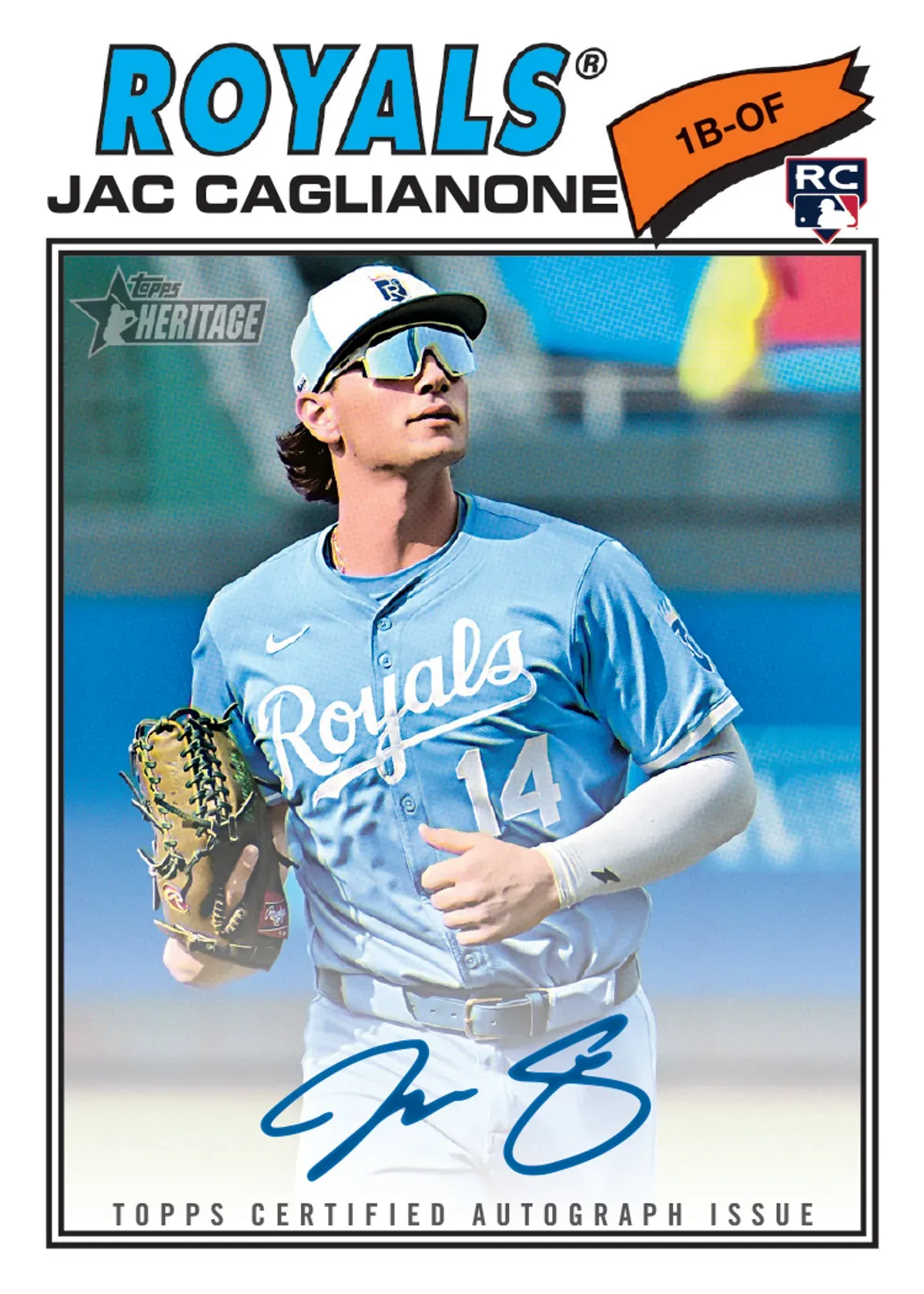
Topps Heritage is Topps’ yearly baseball set that prints today’s players, plus some retired ones, on a classic Topps design from decades earlier. The 2026 edition uses the 1977 look. Its 400-card base set mixes 100 short prints in among the regular cards, adds variations that name themselves on the card back, and comes with a full Chrome version whose colored-border Refractors are numbered. Real One Autographs are its main signed set.
How does Heritage choose its design?
It moves forward one year at a time. Topps launched Heritage in 2001, its fiftieth anniversary, on the 1952 Topps design, then used 1953 for 2002, 1954 for 2003 and so on. The 2025 edition uses the 1976 design, and 2026 uses 1977. By Rip.fan’s arithmetic, that puts the design year 49 years before the edition year.
Heritage is not a reprint set. Topps took the old design and applied it to current players. The 2001 base set had 407 cards, with the last 97 as short prints. The 407-card total and the 97 short-printed high numbers both match the original 1952 set.
The design year also shows up in print runs. In 2026, the Color of the Year parallel called Heritage Orange, the Black Bordered Refractor and the Red Ink autographs are each numbered to 77. In 2025 the Red Ink autographs were numbered to 76.
What is in the 2026 base set?
The 400-card base set was released March 18, 2026. It covers statistical leaders and record breakers, plus a new subset, Turn Back the Clock, whose five cards show retired stars such as Derek Jeter and Ichiro.
The big change from 2025 is where the short prints sit. Topps dropped the recent habit of adding 100 high-number short prints on top of the base set:
| 2025 Heritage | 2026 Heritage | |
|---|---|---|
| Design year | 1976 | 1977 |
| Base set | 500 cards | 400 cards |
| Short prints | 100, cards 401 to 500 | 100, scattered through the set |
| Hobby rate for a short print | 1:4 | 1:3 |
| Hobby box | 24 packs of 8 cards | 20 packs of 8 cards |
In 2026, the short prints run from card 14 to card 400, and 22 of the 57 cards marked RC are short prints. So a rookie’s card number alone no longer tells you whether it is a short print. Check the SP mark on the checklist.
How do you spot a variation?
Turn the card over. Each 2026 variation prints its type beside the card number on the back, for example IMAGE or NICKNAME. These are five of the six variation sets, with their counts and hobby rates (how often a card turns up in hobby packs):
| Variation | Cards | Listed hobby rate | Back text |
|---|---|---|---|
| Image | 50 | 1:80 | IMAGE |
| Alternate Banner | 20 | 1:201 | BANNER |
| Nickname | 10 | 1:401 | NICKNAME |
| Black and White Image | 40 | 1:3,326 | BLACK & WHITE |
| Throwback Jersey | 10 | 1:13,341 | THROWBACK JERSEY |
A sixth set, a logo variation new in 2026, has 20 cards at 1:201. The black and white and throwback jersey cards are super short prints. A variation keeps the base card’s number (the Aaron Judge image variation is card 10, like his base card), so a listing should say which version it is.
What parallels does the paper base set have?
Most are colored borders, and the formats have colors of their own. There are Dark Gray borders in hobby boxes, Dark Green and Red bordered versions, a Deckle Edge version and Heritage Orange numbered to 77. There is also Light Purple for hanger packs, Dark Yellow for fat packs, a hobby-only Black Bordered version at 1:121 hobby packs, and a hobby-only Flip Stock version at 1:1,200. Our guide to sports card parallels explains how colored parallels work in general.
How does Heritage Chrome work?
Every one of the 400 base cards also comes on chromium stock, at 1:4 hobby packs. That is newer than it sounds. The 2001 Chrome cards were a partial parallel of 110 cards, each numbered to 552. 2025 was the first year a full Chrome base set came with its own parallels.
The 2026 Chrome ladder, with hobby rates:
| Chrome parallel | Print run | Listed hobby rate |
|---|---|---|
| Refractor | Not numbered | 1:10 |
| Light Blue Sparkle Refractor (hobby only) | Not numbered | 1:3 |
| Blue Bordered Refractor | 150 | 1:78 |
| Green Bordered Refractor | 99 | 1:273 |
| Black Bordered Refractor | 77 | 1:350 |
| Gold Bordered Refractor | 50 | 1:539 |
| Orange Bordered Refractor | 25 | 1:1,078 |
| Red Bordered Refractor | 5 | 1:5,374 |
| SuperFractor | 1 | 1:27,727 |
Each retail format has its own unnumbered Sparkle color, including Burgundy for hangers and Aqua for fat packs. Pink and Silver Sparkle versions exist too. Two cards numbered to 77 can be different parallels, a paper Heritage Orange or a Black Bordered Refractor, so read the finish as well as the stamp. Our guide to serial-numbered cards covers the stamp itself.
What are Real One autographs?
They are Heritage’s main autograph set, part of the set’s hard-signed content, and a good fit for fans of on-card autographs. The idea goes back to 2001: the first set had 50 signed cards, 24 of players from 1952 and 26 of current players, and later Heritage sets call the autograph set Real One Autographs. In 2026 there are 114 cards: 13 with a 77RO- prefix for players such as Johnny Bench and Mike Schmidt, and 101 with an ROA- prefix for current players, rookies and retired stars. The hobby rate is 1:225, and the Red Ink version, numbered to 77, is 1:1,575.
Smaller signed sets surround it:
- Chrome Autographs, 13 cards, with Gold Bordered (50), Orange Bordered (25), Red Bordered (5) and SuperFractor (1) versions.
- Expansion Autographs, 8 cards of players from the 1977 Mariners and Blue Jays, the two expansion clubs of that year.
- Turn Back the Clock Autographs, 7 cards, and Real One dual and quad autographs.
Memorabilia comes mainly from Clubhouse Collection Relics, 98 cards at 1:29 hobby packs, and the new Real One Relics, 50 cards. The Red versions of both are numbered to 50 and the Patch versions to 1. Our guide to sticker and on-card autographs explains why the signing method matters to buyers.
What is in a 2026 box?
| Format | Packs per box | Cards per pack | Boxes per case |
|---|---|---|---|
| Hobby | 20 | 8 | 12 |
| Mega | 17 | 8 | 20 |
| Value blaster | 8 | 8 | 40 |
A hobby box holds one autograph or relic, 8 Dark Gray Bordered parallels, 8 Light Blue Sparkle Refractors, 8 cards that are variations, short prints or numbered parallels, and 3 inserts. By Rip.fan’s arithmetic, a hobby box holds 160 cards. Our guide to hobby and retail boxes explains why the formats differ.
How to check a Heritage card before you buy
- Find the year and card number on the checklist, and look for the SP mark. In 2026 the short prints run from card 14 to card 400.
- Read the back for a variation word beside the number.
- For a numbered card, match the stamp to the finish: paper border or Chrome Refractor.
- For a Real One, check for the Red Ink version and match its stamp to 77 (or 76 for 2025).
- Measure the borders with our centering checker, then price the exact version from recent sales, as our guide to finding what a card sold for explains.
Rip.fan’s card price lookup covers English Pokémon cards only, so sold listings are the place to price Heritage. Our guide to reading a sports card checklist explains the codes, our guides to Topps Series 1 and 2, Topps Chrome and Bowman Draft cover other Topps baseball sets, and the sports cards hub gathers the rest.
Frequently asked questions
Which inserts are in 2026 Topps Heritage?
Raw Power ties top sluggers to the creation of the Department of Energy in 1977. The insert called Ready, and Action shows in-game photos on a film strip design, and The Enterprise honors the space shuttle Enterprise and its first flight in 1977.
Why are Red Ink autographs numbered to the design year?
The idea dates to 2001, when each signer did 200 unnumbered cards in blue ink and only 52 hand-numbered cards in red ink, matching the 1952 design.
What were the Willie Mays AutoProof cards?
25 original 1952 Topps Willie Mays cards that Topps bought back, had Mays sign and hand-numbered, then placed in 2001 Heritage hobby boxes as box toppers.
Are Topps Heritage cards the size of the originals?
No. Even the 2001 set, on the 1952 design, used the modern size of 2 1/2 by 3 1/2 inches rather than the original 2 5/8 by 3 3/4 inches.
Was Topps Heritage ever made for other sports?
Yes. It began in 2001 in Topps' baseball, football and hockey lines, and became a baseball-only brand in 2007.