Topps Series 1 and 2 explained: rookies and parallels
How Topps flagship baseball is built: the 350-card Series 1, Series 2 and Update sets, rookie flags, foil parallels by box type, and what a hobby box lists.
By the Rip.fan Editorial Team.
Published 8 min read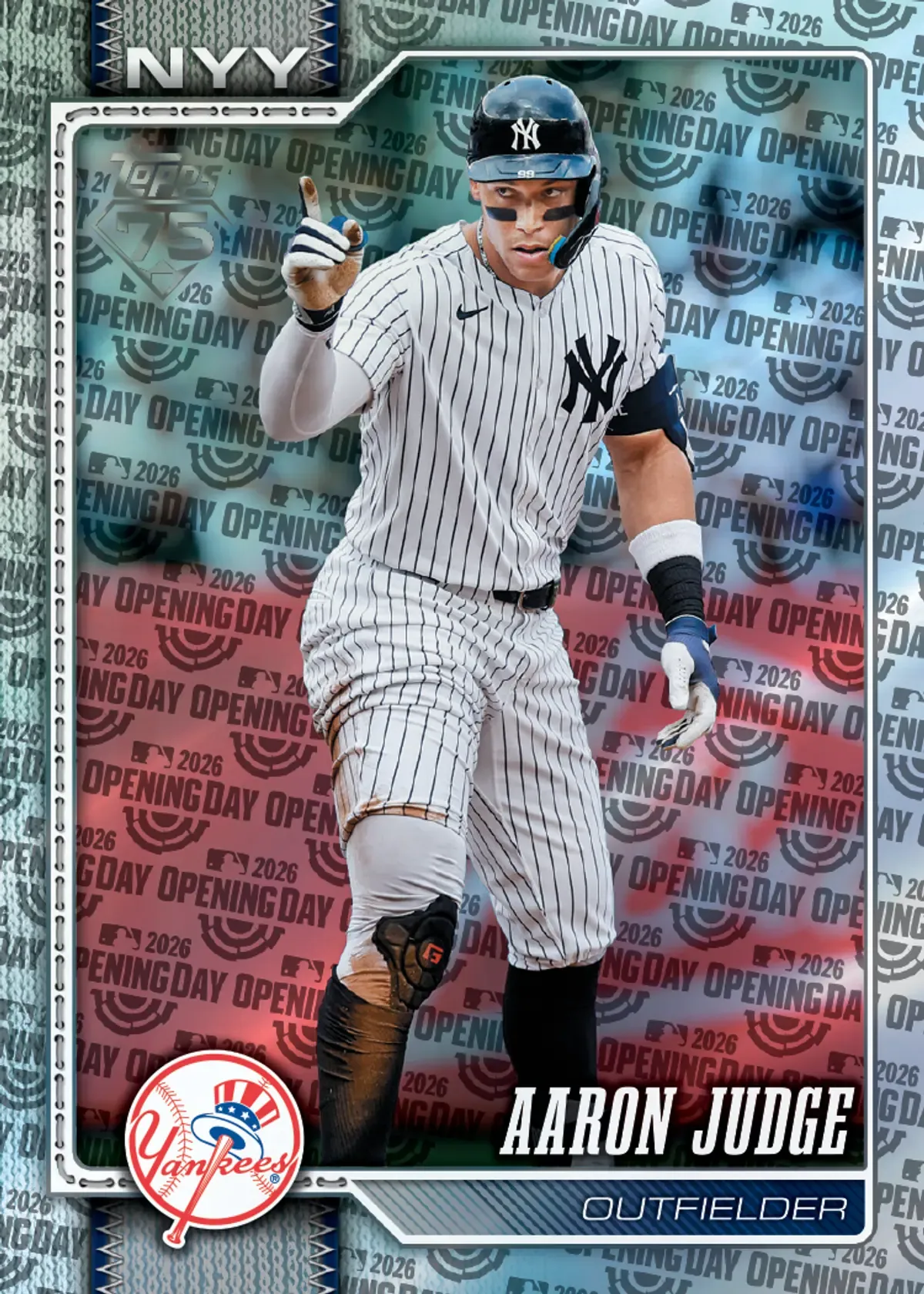
Topps Series 1 and Series 2 are the first two releases of Topps’ flagship baseball set each year, and Update is the third, which closes the year. In 2026 each one lists 350 base cards: Series 1 runs from 1 to 350, Series 2 carries on from 351 to 700, and Update uses its own US numbers. Around the base set sit rookie flags, a long run of foil parallels whose finish changes with the type of box, image variations, inserts, and autograph and relic cards.
How do Series 1, Series 2 and Update fit together?
2026 Series 1 marks 75 years of Topps baseball cards, which began in 1951, and the whole year is a 75th anniversary celebration. Series 2 continues the base numbering and many of the insert and autograph sets. Update adds a third block of rookies, traded players and recent call-ups. The 2026 Complete Factory Set holds the full Series 1 and Series 2 base lineup.
| Series 1 | Series 2 | Update | |
|---|---|---|---|
| Base cards | 350 | 350 | 350 |
| Card numbers | 1 to 350 | 351 to 700 | US1 to US350 |
| Rookie flags | 71 RC | 52 RC | 85 RC and 40 RD |
| Release date | February 11, 2026 | June 10, 2026 | Listed for October 14, 2026 |
| Hobby box | 20 packs of 12 cards | 20 packs of 12 cards | 20 packs of 12 cards |
| What the hobby box lists | One autograph or relic card | One autograph or relic card | One autograph or relic card |
How is a rookie card marked?
The checklists print RC after the player’s name, as on card 4 in Series 1, Jonah Tong.
Update adds a second flag, RD, for the Rookie Debut cards in its base set. It has 85 RC cards and 40 RD cards, 125 in all. One player can have both: Jose Fernandez has an RC card at US66 and an RD card at US74. Our guide to what counts as a rookie card explains the baseball RC logo and the rules behind it, and the rookie card entry has the short version.
Rookies also turn up in versions of their own. Series 1 has 25 1952 Rookie Variations, which put this year’s rookies in the 1952 Topps design and are listed at 1:13,813 hobby packs. Series 2 adds a four-card Rookies Short Prints set, listed at 1:1,750 hobby packs.
How do the parallels work?
A parallel copies a base card, keeps its number and changes the finish, and most are serial-numbered. The 2026 flagship has two kinds: parallels found across most box types, and foil finishes tied to one type of box.
Parallels found across box types
These are the 2026 Series 1 parallels. The last column multiplies each run by the 350 base cards, assuming every base card has the parallel.
| Parallel | Print run | Listed hobby rate | Copies across the base set (Rip.fan’s arithmetic) |
|---|---|---|---|
| Gold | 2,026 | 1:49 | 709,100 |
| Independence Day | 76 | 1:1,302 | 26,600 |
| 75 Years of Topps | 75 | 1:1,319 | 26,250 |
| Black Border | 75 | 1:1,319 | 26,250 |
| Canvas | 50 | 1:1,981 | 17,500 |
| Memorial Day Camo | 25 | 1:3,961 | 8,750 |
| Wood | 25 | 1:3,961 | 8,750 |
| First Card | 1 | 1:100,458 | 350 |
Rainbow Foil comes at 1:11 in hobby.
The arithmetic shows why a serial number alone says little about how many copies exist. A Gold card is stamped out of 2,026, and across the set that comes to more copies than every other numbered row in the table combined. Printing plates are 1 of 1 too: they come at 1:25,115 hobby packs, in four plate colors, black, cyan, magenta and yellow. Our guide to serial-numbered cards explains how to read the stamp.
Foil finishes tied to one type of box
The finish tells you which kind of box a card came from, and a listing that says only “Gold /50” could mean any of five cards: the Rainbow, Holo, Diamante and Sandglitter versions below, and the Spring Training Gold that value blasters carry. The 2026 Series 1 ladder:
| Print run | Hobby and jumbo: Rainbow Foil | Retail boxes: Holo Foil | Hangers: Diamante Foil | Jumbo only: Sandglitter |
|---|---|---|---|---|
| 800 | None | Pink | None | None |
| 399 | Yellow | Yellow | None | None |
| 250 | Purple | Purple | None | None |
| 150 | Blue | Blue | None | None |
| 99 | Green | Green | Green | None |
| 50 | Gold | Gold | Gold | Gold |
| 25 | Orange | Orange | Orange | Orange |
| 10 | Black | Black | Black | Black |
| 5 | Red | Red | Red | Red |
| 1 | FoilFractor | Rose Gold | None | None |
Each family also has unnumbered versions: Holo Foil and Aqua Holo Foil in retail boxes, Diamante Foil and Pink Diamante Foil in hangers, and plain Sandglitter in jumbo boxes. The plain Rainbow Foil and Aqua Rainbow Foil are not tied to one box and are listed in most formats. Value blasters carry a Spring Training family of their own, and its Gold is numbered to 50 as well.
Series 2 repeats the Rainbow, Diamante and Sandglitter families on the same runs. It also has a Holo family and a Value Blaster family of Holiday parallels.
What are the variations?
Variations keep the base number but change the photo, the border or the back. For several of them a code is printed on the back, which helps tell one from the base card. From the 2026 Series 1 list:
| Variation | Cards | Listed hobby rate | How to tell |
|---|---|---|---|
| Golden Mirror | All 350 | 1:1,141 | Gold foil back, code CMP123329 |
| Team Color Border | 100 | 1:229 | Back code CMP123335 |
| Player Number | 100 | 1:2,003 | Back code CMP123338 |
| True Photo | 100 | 1:3,460 | Back code CMP123339 |
| Vintage Stock | 100 | 1:3,497 | Serial number |
| Clear | 100 | 1:4,004, hobby only | Serial number |
Vintage Stock has a print run of 99 and Clear has a print run of 10.
Series 2 has its own Golden Mirror run for cards 351 to 700, and Update has one for US1 to US350.
What inserts and autograph cards come in the packs?
Insert cards are sets with their own design and numbering. In 2026 Series 1 the most common in hobby packs is 1991 Topps Baseball, 100 cards in the 1991 design for its 35th anniversary, listed at 1:4 hobby packs. Others include Topps Profiles (25 cards, 1:16), the 2025 All Topps Team (12 cards, 1:34) and First Pitch (9 cards, 1:45). Heavy Lumber and Home Field Advantage are listed at 1:3,460 each, and Stars of MLB is one of two retail exclusive sets.
Each Series 1 hobby box also holds one Silver Pack. Two sets are Silver Pack exclusives, found only in hobby and jumbo boxes: 1991 Topps Chrome cards and 1991 Topps Chrome Mojo Autographs.
The autograph and relic card in each hobby box comes from sets like these, with the 2026 Series 1 rates:
| Set | Cards | Listed hobby rate | Notes |
|---|---|---|---|
| 1991 Topps Relics | 91 | 1:77 | |
| Major League Material Relics | 87 | 1:91 | |
| 1991 Topps Autographs | 185 | 1:190 | |
| City Connect Swatch Collection | 50 | 1:376 | Hobby and jumbo only |
| Baseball Stars Autographs | 83 | 1:439 | |
| Flagship Real One Autographs | 48 | 1:1,246 | |
| Topps Flagship Autograph Patch | 17 | 1:12,437 | Numbered to 50 or fewer, hobby and jumbo only |
| In The Name Relics | 58 | 1:20,573 | 1 of 1, hobby and jumbo only |
The rates are per pack, while “one per hobby box” is a box figure. Our guide to patch cards and rookie patch autographs explains memorabilia cards, and the autograph card entry covers signed cards.
Which box formats are there?
The 2026 Series 1 formats:
| Format | Packs and cards | What the box lists |
|---|---|---|
| Hobby | 20 packs of 12 | One autograph or relic card, one Silver Pack |
| Jumbo | 10 packs of 40 | One autograph and one relic card |
| Mega | 14 packs of 14 | Three 1991 Topps Crackle Foil parallels |
Series 2 also has a Value Blaster of 6 packs of 12 cards with three Holiday parallels. Rates do not compare well across formats, because the packs differ in size: the Series 1 Gold is listed at 1:49 hobby packs and 1:13 jumbo packs, but a jumbo pack holds 40 cards against 12. Our guide to hobby and retail boxes explains the formats, and sports card sets by tier shows where the flagship sits beside other sets.
How to check a flagship card before you buy
- Read the card number. Numbers 1 to 350 are Series 1, 351 to 700 are Series 2, and a US prefix means Update.
- For a rookie, confirm the RC or RD flag on the checklist.
- Name the finish as well as the color: Rainbow Foil, Holo Foil, Diamante Foil or Sandglitter. Then match the stamp to the run for that finish.
- Turn the card over. A gold foil back means Golden Mirror, and several other variations carry a CMP code on the back.
- Check centering with our centering checker, then price the card from sales of the exact version, as our guide to valuing a sports card explains.
If you plan to grade a card, the grading cost calculator lists grading service levels, prices and estimated waits, each with the day its price was read. For the chromium version of the flagship, see Topps Chrome explained, and for spotting reprinted or faked flagship cards, see how to spot fake sports cards. The sports cards hub lists the rest of Rip.fan’s sports coverage.
Frequently asked questions
Who is on the 2026 Topps Series 1 box?
Hank Aaron, Ken Griffey Jr., Shohei Ohtani and Aaron Judge, a lineup that spans several eras of Topps baseball.
What does the 2026 Topps flagship design look like?
A framed layout styled like a jersey, with stitching in several places and a fabric-like look.
Has Topps had a 75th anniversary before?
Yes. In 2013 Topps marked 75 years as a company, which got its start in chewing gum before it moved into cards.
What is in the Bitty Pop version of the 2026 Topps Update Super Box?
One Flagship Collection pack, an oversized card and a Funko Bitty Pop figure.