Lastpack review: card packs with a 100% sell-back
Lastpack sells packs of real Pokémon, One Piece, Riftbound, Dragon Ball and basketball cards, shows each pack's card rates before you buy, and buys any card back at 100% of its market value.

- Packs from $0.25
- Games
- Trade-in offer 100% of listed value
- Apps iPhone
The short version
Lastpack is a site we recommend, and two things drew us to it: how many packs there are to choose from, and a sell-back that pays a card’s full market value. Its packs cover Pokémon, One Piece, Riftbound, Dragon Ball and basketball, at prices from under a dollar into the thousands, and every pack page sets out its card rates before you pay. New users get free packs when they sign up.
The one thing to plan around is time. A card you want to keep has to be shipped within a week, because one left longer is sold back for you.
Pros
- Any card sold back at once for 100% of its market value
- Packs for Pokémon, One Piece, Riftbound, Dragon Ball and basketball
- Card rates and each pack's lowest and highest card value up front
- Over 200,000 cards owned and insured in its own warehouse
- Cards ship from California, aiming for five business days
Cons
- A card not shipped within seven days is sold back for you
- Only money from cards sold back can be withdrawn
- Sign-up needs a US phone number, and an ID check can follow
- No Android app: Android users use the website
Scores
The score averages these criteria by their weights. How we rate sites
| Criterion | Weight | Our score |
|---|---|---|
| Trust and track record | 20% | 8.5 out of 10 |
| Card rates published | 15% | 9 out of 10 |
| Trade-in terms | 15% | 9 out of 10 |
| Fees | 15% | 8 out of 10 |
| Bank transfer speed | 10% | 8 out of 10 |
| Shipping and vault | 10% | 8.5 out of 10 |
| App and site | 8% | 9.5 out of 10 |
| Support | 7% | 8.5 out of 10 |
What Lastpack is and how it works
Lastpack sells packs of real trading cards, raw singles and graded slabs, on its website and in its iPhone app. Android users use the website, which is where we looked around too. Each pack gives one card from that pack’s pool.
- Sign up and add money to your account balance.
- Pick a pack and read its card rates.
- Open it. The card goes to your Stash, where Lastpack keeps it for you.
- Decide on the card. Ship it home, or sell it back at 100% of its market value.
Lastpack says it owns and insures over 200,000 cards in its own warehouse in California, so a card you keep ships from its own shelves. Our guide to how online pack opening works covers the steps most sites share.
What new users get
New Lastpack users get free packs when they sign up, once the account passes Lastpack’s sign-up checks. The offer is for new accounts only, one account per person. Several sign-ups from one network in a short time can lose the free packs, even when different people share that network. So if friends or family are joining too, don’t all sign up from the same wifi at once.
Using the site
We signed in with our own account and looked through the home page and two pack pages. The site is dark, with yellow-green buttons. The bar at the top holds one menu, Packs, and our balance sat beside an Add funds button on every page.
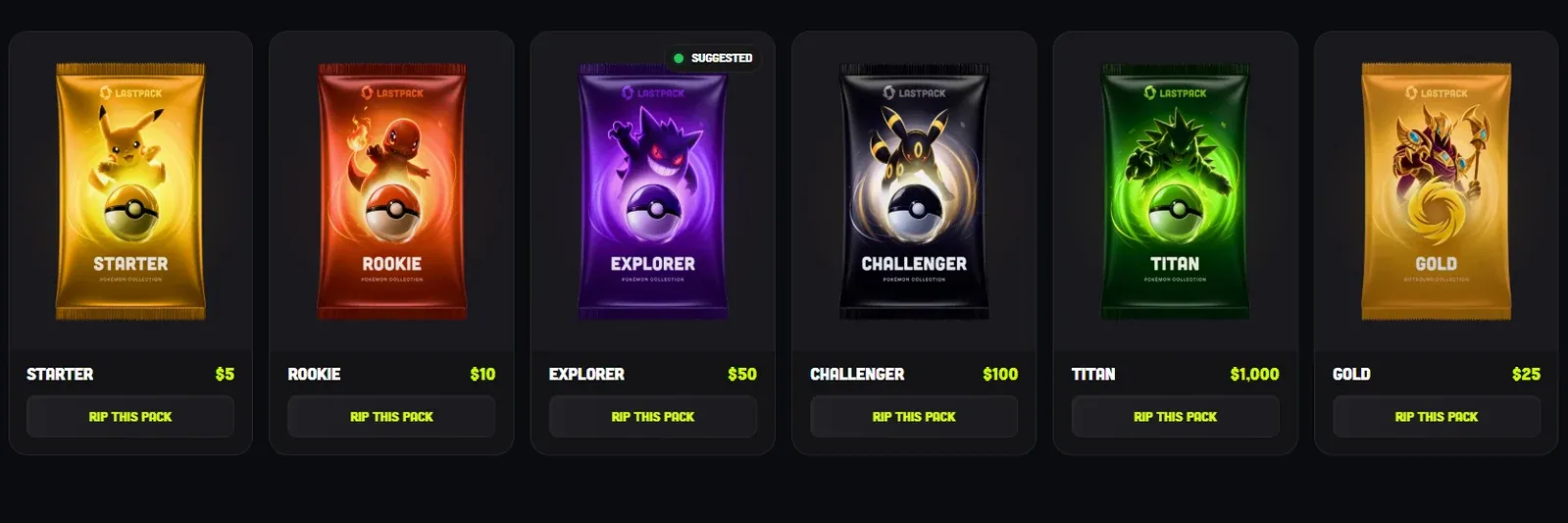
Under its How it works panel, the home page shows six top packs, each with its price and a button to open it.
On a pack page the wrapper fills the left side, and a panel on the right holds the rest: a menu that switches collection, a second menu with the pack’s name and price, its card rates, a quantity picker and a buy button. Under the wrapper, a row of dots counts the packs in that collection. We counted eleven on the Pokémon page and nine on the Riftbound page.
On November 9, 2026 its iPhone app was rated 4.6 from 1,605 App Store ratings.
Packs and prices
Lastpack’s packs run from $0.25 to $2,500. These are the eight our screens showed, cheapest first:
| Pack | Collection | Price |
|---|---|---|
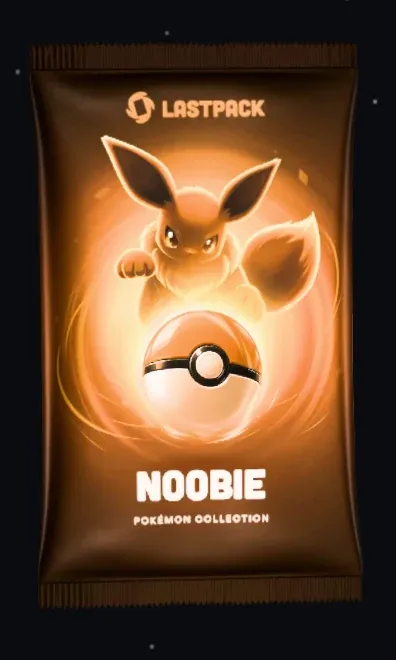
| Noobie | Pokémon | $1 |
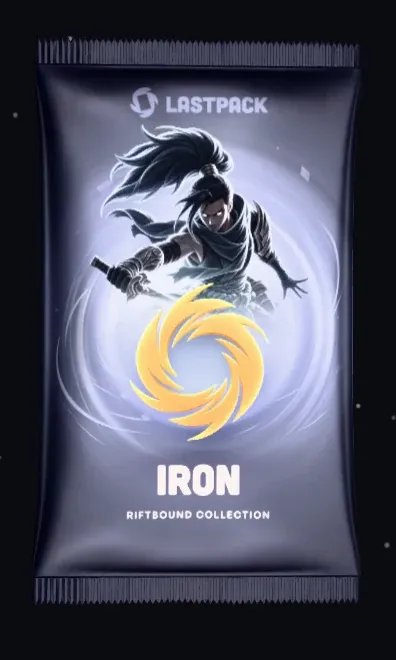
| Iron | Riftbound | $1 |
| Starter | Pokémon | $5 |
| Rookie | Pokémon | $10 |
| Gold | Riftbound | $25 |
| Explorer | Pokémon | $50 |
| Challenger | Pokémon | $100 |
| Titan | Pokémon | $1,000 |
The spread is what we like. One dollar buys a pack of Pokémon or of Riftbound, and the list climbs in steps from there. The Iron pack’s button read Sold out when we looked, so if the pack you want is gone, try the same price in another collection.
Card rates
Every pack page sets out, before you pay, the pack’s sell-back share, the lowest and highest card value it can give, six value tiers, each with its range and how often it comes up, and its top cards. We read the tables on the Noobie and Iron packs.
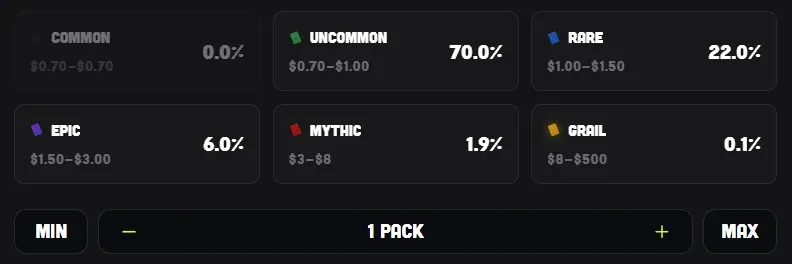
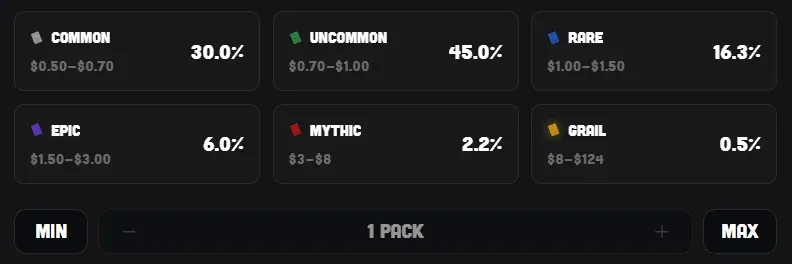
On Noobie the lowest tier stood empty, the next took seven cards in ten, the one above it about one in five, and the top tier one in a thousand. On Iron the two lowest tiers took three cards in four between them, and the top tier came up once in two hundred. Most cards land low, and the tables say so plainly.
DYLI and GrailCart show more, naming every card a pack holds. Lastpack stops at the tiers and the top cards, as Pullz does. Our glossary entry on card rates explains how to weigh a table like this.
Paying
Lastpack takes a card, Apple Pay, Google Pay, PayPal, Venmo and Cash App, depending on your account, your device and where you are. The money goes into your account balance, and no fee is named on buying a pack. None of the four sites we set beside it below takes PayPal or Venmo.
Trade-in offers and selling
Any card in your Stash can be sold back to Lastpack at once, at 100% of its fair market value, with no fee taken off, and the money goes to your account balance. Both pack pages we read showed that share above the buy button. No share can go higher: a card you don’t want is worth its whole listed value toward your next pack.
Money from cards you sell back can leave your account, by bank transfer or, where offered, to a card, Venmo or PayPal, once you have signed in with two-factor. The minimum, any fee and the delivery options, an instant or same-day one among them, show before you confirm.
The Stash and shipping
A card can sit in your Stash for seven days at most, and one you have not shipped by then is sold back for you, at the value set when you opened it. So settle on the keepers early.
Everything ships from California, packed by hand: raw cards in toploaders, graded cards in slab sleeves, tracked and insured, aiming to reach you within five business days. Shipping is charged per card or slab, and the checkout itemizes postage, sales tax and any handling, signature or insurance charge before you pay. Cards you ask for within 24 hours of each other go in one package, up to 10 to a box, so send your keepers together.
Support and who runs Lastpack
Lotus Digital Inc., a Delaware company, runs Lastpack. Support answers by live chat on the website and in the app and by email, with a help center of 13 articles. If a parcel goes missing or arrives damaged, Lastpack files the claim with the carrier and covers the card up to its insured value. Send photos within a week of delivery.
Lastpack is new: its iPhone app came out in October 2026. Both pack pages we read set out the price, the sell-back share and the card rates up front, which we like.
How Lastpack compares
We would weigh Lastpack against these four sites.
| Site | Our score | Instant trade-in offer | Packs from |
|---|---|---|---|
| Lastpack | 8.6 | 100% of listed value | $0.25 |
| DYLI | 8.7 | 90% of listed value | $1 |
| Beezie | 8.6 | 85% to 90% of listed value less a 6% fee | $30 |
| Glyde | 8.5 | 85% to 93% of listed value | $25 |
| Packed | 8.4 | 100% of listed value, 24 hours | $1 |
Lastpack has the cheapest pack of the five. On trade-ins, Lastpack and Packed each pay the whole of a card’s listed value, with no fee. DYLI pays a smaller share, and the shares at Glyde and Beezie vary by pack and stop short of the whole. A share is only as good as the value it is a share of, and every site sets its own, so read these as a rough guide.
Packed’s clock is shorter than Lastpack’s: a card left in its vault for 24 hours is sold back for you. Beezie stores what you keep free in a Brink’s vault, and DYLI holds cards in an insured vault where you can also list them for sale. If you like to sit on cards, those two suit you better.
Lastpack is the one of the five with Dragon Ball packs. Our compare tool sets these sites side by side.
Worth knowing before you buy
- Lastpack sets the values. A card’s fair market value is Lastpack’s own figure, worked out from recent sales, and the full-value offer rests on it. Before you sell back a card you would happily keep, look up its recent sold prices. Our guide to judging an instant trade-in offer shows how.
- Go by the rates on the day. A pack’s rates follow Lastpack’s stock and move as cards come and go, so the rates on the page when you buy are the ones that count.
- Money you add stays in. Only money from cards you sell back can be taken out again. What you add buys packs.
- It is for collectors in the US. Signing up takes a personal US phone number, and Lastpack can ask for a photo ID and a live selfie before you add money, buy, ship or take money out.
Final verdict
We like Lastpack. It gives you a lot of packs to choose from, across five kinds of cards and from $0.25 to $2,500, shows each pack’s card rates before you pay, and buys any card back for 100% of its market value. It suits collectors in the US who want plenty of choice and settle quickly which cards to keep. To get the most from it, sign up for the free packs, read a pack’s tiers before you buy, and send your keepers home together inside the week.
How we scored it
Our own use of Lastpack was a signed-in look through its home page and two pack pages, with screenshots kept as we went. The score rests on the facts Lastpack publishes about its packs, card rates, trade-in offer, shipping, withdrawals and support, and on its App Store listing, on the same criteria we use for every site. This review is a human and AI collaboration: our own look at the site supplied the notes and screenshots, and AI read Lastpack’s pages and wrote the review from them.
Frequently asked questions
What does Lastpack sell?
Packs of real trading cards, raw and graded, for Pokémon, One Piece, Riftbound, Dragon Ball and basketball, from $0.25 to $2,500, on its website and its iPhone app. Each pack gives one card.
Does Lastpack give new users free packs?
Yes. New Lastpack users get free packs when they sign up, once their account passes Lastpack's sign-up checks.
Does Lastpack show card rates?
Yes. Every pack page shows the lowest and highest card value it can give, six value tiers with how often each comes up, and the top cards still in the pack, before you buy.
Can you sell a card back to Lastpack?
Yes, at once, at 100% of the fair market value Lastpack sets for it, with no fee taken off. The money goes to your account balance.
How long does Lastpack keep your cards?
Up to a week. A card you have not shipped by then is sold back for you, at the value set when you opened it.
Where does Lastpack ship from?
From its own warehouse in California, packed by hand, tracked and insured, aiming to reach you within five business days. Up to 10 cards you ask to ship within 24 hours go in one package.
How do you pay at Lastpack?
By card, Apple Pay, Google Pay, PayPal, Venmo or Cash App, depending on your account, your device and where you are.
Does Lastpack have an app?
Yes, for iPhone. Android users use its website.
Who runs Lastpack?
Lotus Digital Inc., a Delaware company, which says it owns and insures over 200,000 cards in its California warehouse.