How to sell One Piece cards: versions, Japanese, slabs
How to list One Piece singles under the right version, what changes for Japanese cards and slabs, and which TCGplayer and Whatnot tools take One Piece cards.
By the Rip.fan Editorial Team.
Published 8 min read
To sell a One Piece card, name its exact version before anything else: the card number, the rarity label, and whether it is the standard print, an alternate art, a parallel, an SP or a Manga card. Then choose the route. TCGplayer sells English singles against its catalog, where each version has an entry of its own, while Japanese cards and slabs go up with your own photos. eBay and Whatnot also ask for photos of the copy you hold. TCGplayer fulfills orders for sellers only in Magic, Pokémon and Yu-Gi-Oh!, so a One Piece seller packs every TCGplayer order.
Why does the version matter more than the card number?
Because one number can cover several different cards. Search OP06-119, Sanji, on Bandai’s English card list and five versions appear, across three products: two from Wings of the Captain, two from the Premium Booster The Best vol.2, and an SP card from A Fist of Divine Speed. Four of the five carry the same SEC label. “OP06-119 SEC” in a title cannot tell a buyer which copy you hold, so the title and the catalog entry have to say it.
The list doubles as your check. Each version shows with its own image and its product, so you can match the art in your hand before you list. Our guides to checking a One Piece card’s value and One Piece rarities explain the star, SP and TR marks that set versions apart, and the alternate art entry covers the term.
How does TCGplayer name One Piece versions?
With a tag after the card’s name. TCGplayer asks you to confirm that the catalog version matches the card you hold before you add it. The naming pattern looks like this:
| Version | How the catalog name shows it | Example from the reports |
|---|---|---|
| Alternate art | (Alternate Art) | Sabo (004) (Alternate Art), from Carrying On His Will |
| Parallel | (Parallel) | Monkey.D.Luffy (003) (Parallel), from Ultra Deck: The Three Brothers |
| SP | (SP) | Nico Robin (055) (SP), from Extra Booster: One Piece Heroines Edition |
| Manga | The full card number, then (Manga) | Sanji - OP06-119 (Manga), from Premium Booster -The Best- Vol. 2 |
| Gold DON!! card | DON!! Card, the character, then (Gold) | DON!! Card (Boa Hancock) (Gold), from Heroines Edition |
| Promo | The product in parentheses, under One Piece Promotion Cards | Monkey.D.Luffy (English Version 1st Anniversary Set) |
Some catalog names add three digits in parentheses after the card’s name; Edward.Newgate (Alternate Art), from The Time of Battle, has none. In two cases the digits match the end of Bandai’s card number: Sabo is OP13-004 in Carrying On His Will, and the Luffy above is ST13-003 in The Three Brothers. When you list, read the tag, any digits and the set.
How do you list Japanese One Piece cards?
With your own photos, as a Listing with Photos on TCGplayer. Its catalog exception for non-English cards reaches only Japanese Pokémon cards and Magic cards that have language options, so every Japanese One Piece card falls outside it. Four rules shape the listing:
- Use the nearest catalog entry. TCGplayer wants the entry that most closely fits what you are selling.
- Spell the language out. Write Japanese in the title and the description; a code like JPN does not count, and neither does a flag picture or any stock photo.
- Show the real card. TCGplayer suggests photos of at least the front and the back.
- Group identical copies. An uncatalogued non-English card can go up as one listing for several copies, provided the title says the listing is for one copy.
TCGplayer’s Scan & Identify tool recognizes a non-English card only when an English version shares its artwork, so a Japanese card with no English twin has to be matched by hand. On eBay and Whatnot, add the language to the title. Compare a Japanese copy with Japanese sales only, because the two releases differ, as our guide to Japanese and English One Piece cards explains.
Which TCGplayer tools take One Piece cards?
Fewer than for Magic, Pokémon or Yu-Gi-Oh! cards.
| Tool or program | One Piece cards | Who can use it |
|---|---|---|
| Catalog listing | Yes, English singles by version | Every seller, within the level limits |
| Listing with Photos | Yes, and required for graded, signed and non-English cards | Every seller |
| TCGplayer app scanning | Yes; the app scans every kind of card on TCGplayer | Anyone; importing scans into inventory needs Level 4 |
| Scan & Identify (open beta) | Yes, since March 13, 2025 | Level 4 and Pro sellers |
| TCGplayer Direct | No; Magic, Pokémon and Yu-Gi-Oh! singles only | Level 4 sellers who meet its sales targets |
| Managed Inventory (pilot) | No; the same three games, English cards in Near Mint or Lightly Played only | Sellers in the pilot |
So every One Piece order on TCGplayer is yours to pack and ship. Tracking is required above $49.99 and a signature above $250, and tracking above $20 is suggested for your own protection. The app also warns that it may guess the wrong set when two printings share the same art, so check the set on every scan.
What changes for graded One Piece cards?
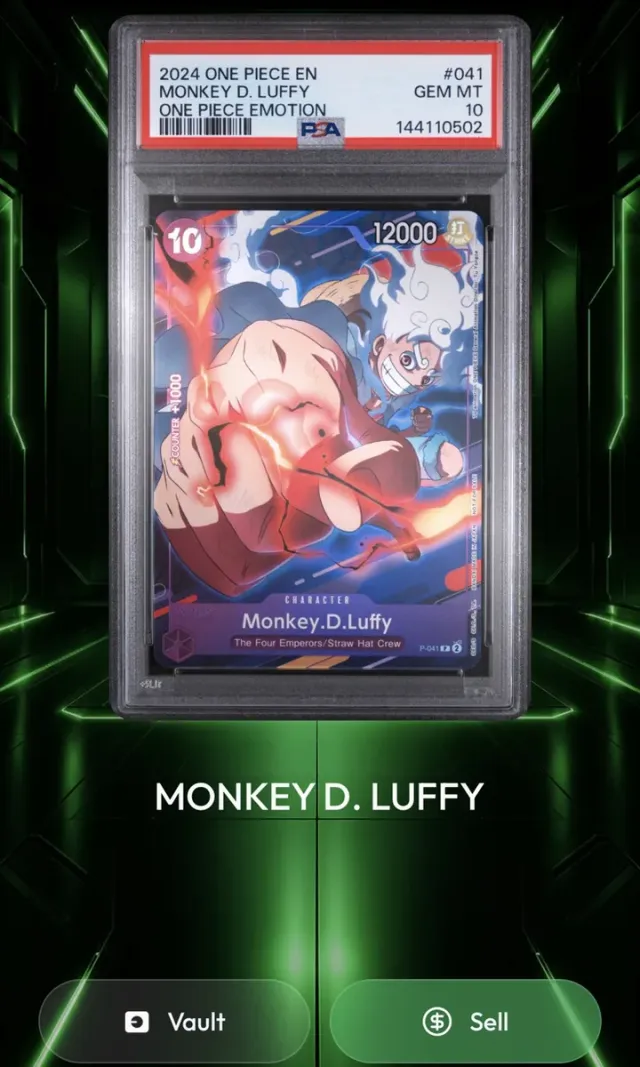
- TCGplayer takes slabs only as Listings with Photos, and your seller level sets the highest price you can ask for one item. Level 1 sellers top out at $500 an item, Level 2 at $1,000 and Level 3 at $20,000. TCGplayer’s report of July 14, 2026 listed the Manga Sanji at a Market Price of $2,274.69, above the $1,000 a Level 2 seller can ask.
- eBay asks for the grader and the grade, and recommends the cert number. Its Authenticity Guarantee covers single cards from $200 in its CCG Individual Cards category, and accepts slabs only from PSA, SGC, CGC (with CSG) and BGS.
- Whatnot can fill in a listing from a scanned slab, on its iPhone app only. The scanner covers CGC for TCG cards and PSA for sports and Pokémon slabs, so a PSA One Piece slab is not on that list. Whatnot wants every slab inside a sleeve made for graded cards, or a team bag.
Our guides to grading Magic, Yu-Gi-Oh! and One Piece cards and selling graded cards cover the rest, and the grading cost calculator shows what CGC and SGC charge by declared value.
What do fees leave on a high-value One Piece card?
Both marketplaces stop growing their commission past a set price, which matters for Manga and SP cards. TCGplayer caps its 10.75% on the card at $75 per item, a ceiling it reaches at about $698, though the same 10.75% also applies to the shipping charge with no cap. Whatnot charges 8% on the TCG category at its standard tier but, under a limited-time promotion running since January 14, 2026, nothing on the part of one order above $1,500, so its commission tops out at $120. Neither caps the payment fees on top: 2.5% plus $0.30 on TCGplayer and 2.9% plus $0.30 on Whatnot, each on the full order total.
| One card sold for | Fees on TCGplayer | Left on TCGplayer | Fees on Whatnot | Left on Whatnot |
|---|---|---|---|---|
| $500 | $68.77 | $431.23 | $56.13 | $443.87 |
| $1,500 (TCGplayer Level 3 or 4) | $116.77 | $1,383.23 | $167.16 | $1,332.84 |
| $3,000 (TCGplayer Level 3 or 4) | $156.90 | $2,843.10 | $213.70 | $2,786.30 |
These figures are Rip.fan’s arithmetic for one card sold on its own, by a standard TCGplayer marketplace seller (not Pro, Direct or sync) and a Whatnot seller at the standard tier. The buyer pays $10 for shipping, which goes on postage, plus 7% tax on card and shipping together. At $500 Whatnot leaves more for two reasons: its 8% is lower than 10.75%, and it charges commission on the card alone, not on shipping and tax. On these assumptions, TCGplayer’s fees fall below Whatnot’s from about $903, once its $75 ceiling has kicked in. Our seller fee calculator runs both sites for any price, and our guide to where to sell cards online covers payment timing and eBay.
How do you sell sealed One Piece product?
TCGplayer defines factory sealed as original, unopened, undamaged packaging that was never resealed or rewrapped, so a box or pack that fails that test is not sealed product on TCGplayer. Packs removed from a booster box sell as single packs. On Whatnot, sealed wax, the hobby term for sealed packs and boxes, ships in a box and never in a padded mailer, and eBay’s Authenticity Guarantee leaves boxes and packs out. Our guides to One Piece booster box contents and selling sealed product go further.
What can’t you list at all?
Copies. TCGplayer prohibits counterfeits and proxies. Whatnot treats any item that copies a brand as counterfeit, and a seller’s note that it is fake, or of unknown authenticity, does not change that. If a card looks wrong, check it against our guide to spotting fake One Piece cards before you list it anywhere.
A checklist before you list
- The card number, the art and the product match one version on Bandai’s card list.
- The TCGplayer entry carries the matching tag and, where it has them, the matching three digits.
- A Japanese card goes up with photos, with Japanese written in full.
- The asking price fits your TCGplayer level, and a slab’s cert number is in the eBay listing.
- The packing fits the item: a team bag for raw cards, a box for sealed product.
For condition names across the three marketplaces, see our guides to selling Pokémon cards and selling Magic cards. Every One Piece guide is listed on the Magic, Yu-Gi-Oh!, One Piece and Lorcana hub.
Frequently asked questions
Does eBay charge more when a One Piece card sells abroad?
Only without eBay International Shipping. On October 27, 2026, a US seller who shipped to a buyer abroad directly paid an international fee of 1.65% of the total sale, and one using eBay International Shipping paid none.
Who can use TCGplayer's Scan & Identify?
Level 4 and Pro sellers have it already, and a Level 1 to 3 seller gets it at once by connecting a Roca Sifter, which brings Level 4 access. An import takes up to 3,500 images, each under 15MB, upright and at least 300 pixels on the short side.
How fast does Whatnot pay for a One Piece sale?
In the US, Whatnot releases the money within about 4 hours of confirmed delivery, and a transfer to the bank usually takes 1 to 2 business days. For a sale shipped as a First-Class Mail letter, the money starts processing 10 days after the label is made, unless the seller qualifies for early release.
How do you show a buyer a One Piece card is real?
With proof TCGplayer accepts: clear photos of the original receipt, a certificate of authenticity, or authentication by a grader such as PSA, BGS, SGC, CGC or CSG. A photo listing may not hedge with lines such as "as far as I can tell, it is authentic."