How to check a One Piece card's value by version
Price a One Piece card by its exact version: number, rarity label, alt-art star, SP or TR mark and language, then a dated sold price for that version alone.
By the Rip.fan Editorial Team.
Published 6 min read
To check a One Piece card’s value, identify the exact version before you look at any price. Read the card number and rarity label in the bottom right corner, look for a star or an SP or TR mark, confirm the language and judge the condition. Then find recent sold prices for that version in that condition, and write down the date. Bandai prints several versions under many card numbers, so a price for the number alone can belong to the wrong card.
Why does one card number carry several prices?
Because Bandai counts card types, and one type can come in several versions. OP-17 has 131 card types plus 4 DON!! cards. The 131 come as 169 entries, because the extra 38 are alt-arts that share a number with a standard print.
Search a number on Bandai’s card list and every version appears. OP17-062, a Super Rare of Kaido, brings up four results: the standard print and three alt-arts, all labeled SR. OP17-118, a Secret Rare, appears three times. Each version sells on its own, so a sale of one is not a comp for another.
Marketplaces split the versions too. TCGplayer’s price reports name them with a tag after the card’s name, such as (Alternate Art), (Parallel), (SP) or (Manga), and (Gold) for a gold DON!! card. Its report of August 19, 2026 listed an alt-art Edward.Newgate from OP-16 at a Market Price of $40.23, under its own tag. When you search a marketplace, add the tag that matches your card.
What do you read on the card?
The corner holds most of what you need. Our guide to One Piece rarities explains each mark in detail.
| What to read | Where it is | Why it matters for price |
|---|---|---|
| Card number | Bottom right, such as OP17-005 | Names the card, but not the version |
| Rarity label | The box after the number | Alt-arts keep the base card’s label |
| Star | Above the rarity box | Appears on the recent alt-art images read (see the note on early sets below) |
| SP or TR mark | A box before the number | On the images read, marks a Special card or a Treasure Rare |
| Language | English or Japanese text; Bandai’s English image of OP17-005 also shows an EN mark | Each language is a separate printing |
| Condition | The card itself | Each condition, and each grade, sells apart |
The number’s prefix names a product, and not always the pack you opened. All 10 Special cards in OP-17 carry numbers from other products, such as OP12-056 or the promo P-084, so search the number and check the art.
How do you confirm the version on Bandai’s card list?
Use the search box. Type the card number, and each version appears with its own image. Match your card’s art to one of them. Three settings help:
- Hide reprint cards. A tick box drops reprints from the results.
- Illustration type. A filter splits art into comic, animation, original illustrations and other.
- Set. A drop-down narrows the list to one product, such as OP-17.
Read the text labels with care. On the lists read, an alt-art carries its standard print’s label, so SR can mean the standard print or an alt-art. Only TR and SP CARD name a version. For a Japanese copy, use Bandai’s Japanese card list, which shows the same 169 entries for OP-17.
Older sets need one more check. On Bandai’s images, the alt-art of OP01-013 shows no star, so for early sets compare the art with the standard print.
Is it English or Japanese?
Read the text, then the small print. Bandai’s English and Japanese images of OP17-005 show the same number and the same SR label. The English image adds EN after the maker’s line on the right edge, and the Japanese one does not.
The two releases differ in more than text. A Japanese OP-17 pack holds 6 cards, and the two came out six days apart, on August 22, 2026 in Japan and August 28 in English, after an English pre-release on August 21. Compare a Japanese copy only with Japanese sales. Our guide to One Piece set release dates lists both dates for every booster.
Where do you read a dated price?
Use completed sales of the exact version, not asking prices. TCGplayer says its Market Price is built from recent sales on its own site. Our guide to finding what a card sold for sets out the method: gather several recent sales of the same version in the same condition, take the middle one, and date it. Our guide to market, listed and sold prices explains what each kind of figure measures.
TCGplayer’s own reports show the filters a careful figure needs. Its report of July 14, 2026 counted only Near Mint copies with at least ten sales from June 8 to July 7, 2026. A market price is built from sales, and comps are the recent sales of the same card you compare.
Why can a One Piece price jump?
One buyer can move it. TCGplayer’s reports trace several sharp rises to single orders for many copies, and the path of one card shows why the date of each sale matters.
| When | What TCGplayer reported for one parallel Luffy (003) from the ST-13 Ultra Deck |
|---|---|
| November 2025 | Stable under $20 |
| December 2025 to January 2026 | Buyouts on December 3, December 31 and January 7, when TCGplayer’s tally put buyers at 14 to 17 copies each, took it to $70 |
| March 2026 | Back to $35 |
| July 14, 2026 report | A Market Price of $90.04, after buyouts that began May 28 and continued July 7 |
The August 19, 2026 report adds another case: on July 19, one buyer took 28 copies of a promo Luffy at once, and the report gave its Market Price as $31.48. So before you trust a new price, read the sales behind it: how many copies each order held, and on which days. A price set by a few large orders is only a figure on a date.
What about promos and condition?
Promo cards carry P numbers on Bandai’s card list, such as P-084, and TCGplayer’s reports file them under One Piece Promotion Cards. Price each one by its own number and version.
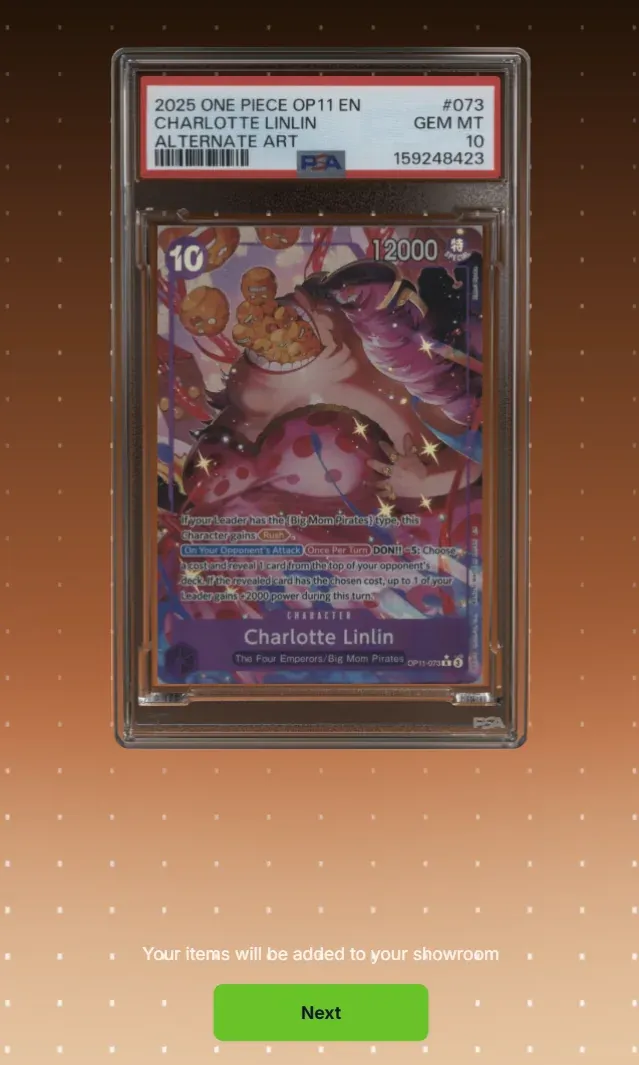
Condition counts as much as the version. A raw card is priced by its condition, and our guide to card condition grades explains the steps. A graded card is a separate item: compare it only with sales of the same grade from the same company, and check its cert number on the grader’s site. Our guide to grading Magic, Yu-Gi-Oh! and One Piece cards covers which services take them, and Rip.fan’s grading cost calculator shows the cheapest and fastest CGC and SGC service levels for a card’s declared value.
Where do Rip.fan’s price pages fit?
Rip.fan’s card price pages cover Pokémon, so for One Piece use the sold-price method above. The Pokémon card pages group those prices by set, and the trading card hub collects our One Piece, Lorcana, Magic and Yu-Gi-Oh! guides. Our guide to checking a Lorcana card’s value applies the same method to another card game.
A quick checklist before you buy or sell
- The card number matches the listing, and so does the art.
- The rarity label, and any star, SP or TR mark, match the version you are pricing.
- The language matches, and so does the condition or the grade and grader.
- The price comes from sales of that version, with dates and quantities you have read.
If any line fails, the price you are reading belongs to a different card.
Frequently asked questions
Which conditions can a One Piece card be listed in on TCGplayer?
Near Mint, Lightly Played, Moderately Played, Heavily Played and Damaged, each with a foil version.
Does a signature or stamp lower a card's condition?
Yes. At TCGplayer, a card with a stamp, signature, paint or marker on it counts as Damaged, and so does one with crimping or a large miscut, whatever its other wear.
Can CGC grade One Piece cards?
Yes. CGC added One Piece cards in October 2022 and grades every language. A card it judges counterfeit comes back marked Questionable Authenticity, and the grading fee is still charged.
How do you list a Japanese One Piece card on TCGplayer?
As a Listing with Photo, the way TCGplayer takes every non-English card except Japanese Pokémon and some Magic cards. Write the language in full in the title and description, such as Japanese rather than JPN.