How to pack cards for grading: CGC and TAG rules
How to pack cards for grading at CGC and TAG, stage by stage: the stack, the paperwork, the seal, box markings, the address, the carrier and cover in transit.
By the Rip.fan Editorial Team.
Published 8 min read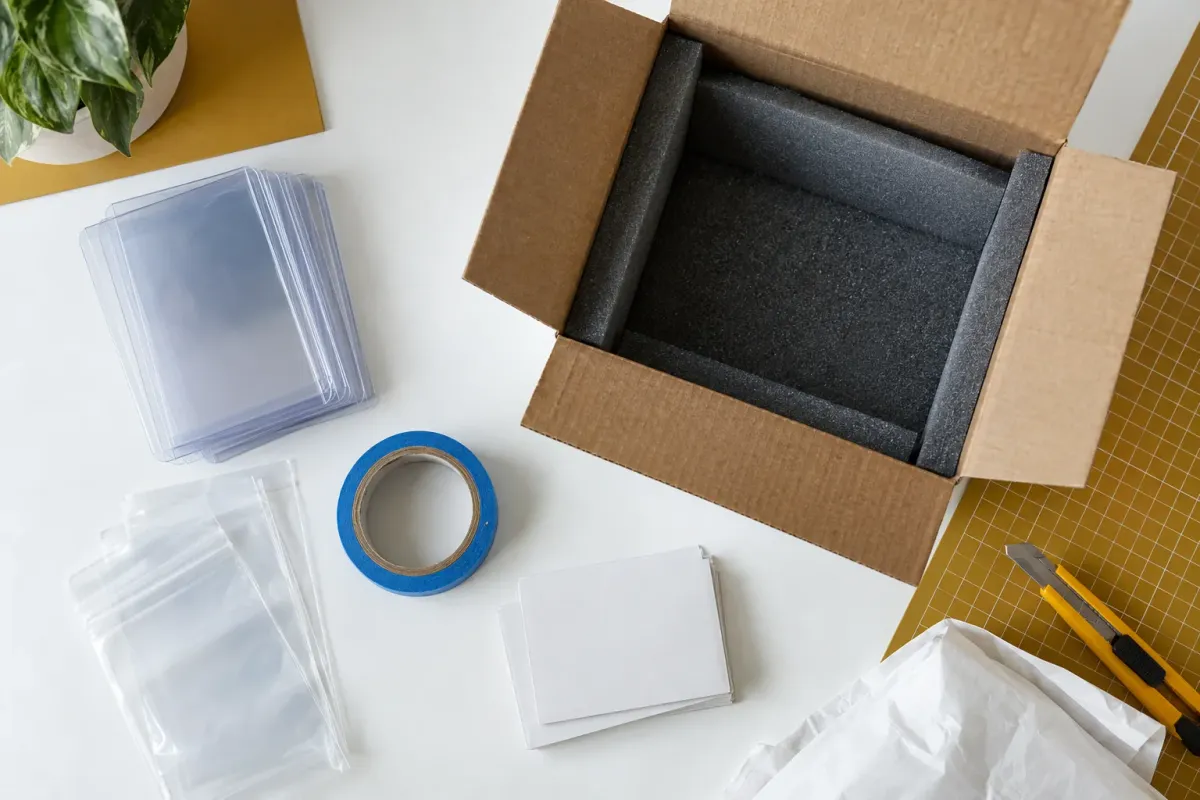
To pack cards for grading, slide each card into a soft sleeve, then into a semi-rigid holder, and stack the cards in the order of your packing slip. Sandwich the stack between two pieces of cardboard and cushion it in a sturdy box with the slip inside. Then seal the box fully, mark it if you paid for a faster level, and send it insured with a carrier that takes a signature. That method meets both CGC’s and TAG’s rules. For SGC, ask before you pack. Which holder does which job is covered in our guide to card sleeves and holders.
What has to happen before you pack?
The paperwork comes first, because the box has to match it.
- CGC. Fill in its online submission form. It produces the packing slip that goes in the box, and the cards must sit in the slip’s order.
- TAG. Buy the level and the number of cards, then enter every card in TAG’s online portal. TAG sends packing and mailing instructions only once the cards are entered. Your packing list is the one in the submission email, or a copy of the order from the portal. If it is not in the box, email TAG your order number, account email, name and address so it can flag the package.
- SGC. Start the order on its website with Start New Submission, or in its app, which can place orders and track them through grading.
Count the cards before you pay TAG, because it cannot add cards to an order later.
How do CGC’s and TAG’s rules compare, stage by stage?
| Stage | CGC | TAG |
|---|---|---|
| Order in the stack | As listed on the packing slip | As listed in your order |
| Binding | Two pieces of cardboard larger than the cards, rubber bands snug but not tight | Slightly larger pieces of cardboard, with painter’s tape or rubber bands |
| Cushioning | Bubble wrap, foam pellets or other packing material | Bubble wrap or shipping paper |
| Box | Sturdy cardboard, with the bundle not packed too tightly | Cardboard, new and undamaged where possible; a bubble mailer is accepted but not recommended |
| Paperwork inside | The packing slip or slips | The packing list or a copy of the order |
| Seal | Packing tape over the whole outside, reinforced tape advised | Not set out |
| Outside marking | EX, WK or UV on every side for those tiers | EX on both sides for Express |
| More than one level or order in a box | Several tiers: mark the box for the fastest | Several orders: keep each apart, with every packing list included |
| Carrier | Not set out; the trip in is yours | UPS, FedEx or DHL recommended |
| Cover on the way in | Yours to arrange | Yours, unless you bought the Submission Kit |
At CGC, a package that arrives damaged, unsealed or poorly sealed is refused and sent back by the shipper. At TAG, a box that arrives heavily worn, damaged or looking tampered with may be sent back unopened.
What is one packing method that meets both?
- Sleeve and hold each card. A soft sleeve, then a semi-rigid holder of 3 5/16 by 4 7/8 inches. TAG requires that size, such as a Card Saver I. CGC asks for a semi-rigid sleeve sturdy enough for its staff to take the card out safely. Do not tape or sticker the holders shut, and do not put single cards in team bags; TAG says both slow its receiving team down.
- Stack the cards in list order. Both companies ask for it.
- Bind the stack. Use two pieces of cardboard a little larger than the cards on either side, held with snug rubber bands, which both companies name. TAG also allows painter’s tape. CGC warns that cards packed too tightly may be damaged.
- Cushion it. Wrap the bundle in bubble wrap.
- Box it. Use a new, sturdy box with room for the padding, and put the packing slip inside.
- Seal it. Tape the outside completely.
- Mark it. Add the marking for a faster level, as set out below.
- Film it. TAG recommends a video of the front and back of every card, the materials and the sealing of the box.
- Ship it. Use insurance and a carrier that takes a signature at the door.
TAG explains the video advice: it generally cannot accept raw photos taken before grading in a dispute, because a card could be damaged while you sleeve it. Our guide to handling cards safely covers loading holders without marking the card.
How do you mark the box?
At CGC, write EX for Express, WK for WalkThrough or UV for Unlimited Value on every side of the box, in large, bold letters. If the box holds several tiers, mark the fastest. A wrongly marked box will be delayed.
At TAG, write EX in dark, bold letters on both sides for Express. TAG also mentions WK for Walkthrough orders, but its list of levels as of September 30, 2026 has no Walkthrough: it runs BASE, STANDARD, PRIORITY, EXPRESS and PREMIER. Mark EX for Express and ask TAG about anything else.
Where does each box go?
| Company | Address for mailed cards |
|---|---|
| CGC | CGC Cards, 6802 Energy Court, Sarasota, Florida 34240 |
| TAG | SK RECEIVING, 5300 Beethoven Street, Penthouse Floor, Los Angeles, California 90066 |
| SGC | SGC, 951 West Yamato Road, Suite 101, Boca Raton, Florida 33431 |
TAG notes that “Penthouse Floor” may not register with some shipping systems, and suggests PH Floor, 4 Fl or Fourth Floor instead. TAG also gives a phone number and an email address for carrier forms that ask for one.
TAG also has older address instructions, dated March 11, 2025, which call a toploader acceptable, name the consignee TAG instead of SK RECEIVING, and say only that USPS orders may be delayed. The June 24, 2026 instructions are newer, so follow them.
Sending from outside the US? At CGC you must name yourself the importer of record, and it bills you for any duties it pays plus a $25 fee. TAG takes direct orders only from the US and Canada, and lists separate addresses in Canada.
Which carrier, and who covers the trip in?
TAG recommends UPS, FedEx or DHL, because those carriers take a signature when the box reaches its door. It cannot confirm receipt of USPS packages, since USPS collects no signature on delivery there.
Cover on the way in is your job at all three:
- CGC makes safe arrival your responsibility, and calls its packing steps suggestions.
- SGC is not responsible for loss or damage while cards are on their way to it.
- TAG is not responsible for damage in transit and recommends an insured service. Its own cover starts when the cards arrive, unless you use its Submission Kit.
What does TAG’s Submission Kit include?
The kit is an add-on to a grading order, at $49.95 in the US. It serves the continental US only and cannot be bought without grading. It ships with shields and sleeves for the number of cards you ordered, and a SafeCase to hold them. A FedEx Padded Pak carries a prepaid label back to TAG. TAG warns not to throw that envelope away. The kit covers the order for up to $1,000 on the way in, it is good for one use, and TAG keeps the SafeCase. It ships only after TAG approves your card list.
The kit bundles the supplies, the label and the inbound cover in one purchase. Its cover tops out at $1,000, so on a more valuable order it protects only part of the value on the way in.
What does SGC ask for?
Ask SGC through its contact form before you pack. Mailed orders go to the Boca Raton address above. Two of its rules matter for the box:
- If you send a card in any case or holder that is broken, tampered with or defective, tell SGC. It takes no responsibility for further damage if it opens or removes such a holder.
- SGC may charge extra for cards larger than 3 1/2 by 5 1/2 inches and for custom holder inserts.
Until SGC answers, the method above is CGC’s and TAG’s, not SGC’s. Our guide to submitting to SGC covers its levels and fees.
What should stay out of the box?
- Anything you need back. CGC does not send back the sleeves, card savers, boards or other materials you include, and asks you not to send a certificate of authenticity.
- Another grader’s slab, at TAG. TAG offers no crossover and says such orders are delayed and may face fees or be sent back.
- Toploaders, magnetic cases, screw-down holders and Card Preservers, at TAG. Cards packed in anything but semi-rigid holders may face delays and handling fees.
What happens once the box arrives?
- CGC shows the order in Submission Tracking once it has checked the contents and entered them.
- TAG shows the cards as Received in its portal within 5 to 10 business days of arrival.
- SGC starts its estimated wait once the order is unboxed and logged.
Our guide to card grading mistakes to avoid covers what goes wrong before and after this stage. Checking a graded card’s cert covers the slabs when they come back, and how long grading takes sets out the waits. The glossary explains a slab and a service level.
Frequently asked questions
Can you change a CGC order after mailing the box?
No. CGC cannot change or cancel an order once it is in transit to its facility, so check the form against the stack before you seal the box.
Can you swap cards in a TAG order after packing?
Yes, on a self-mailed order: click EDIT on its entered cards in TAG's portal any time before the box reaches TAG, then reprint the packing list. A Submission Kit order locks once the kit is approved, and changes then go through customer service.
Do you need a TAG account before you order?
No. TAG creates an account automatically after the purchase, under the email used to place the order, and you sign in with that email to start the card entry.
Where do Canadians send cards to TAG?
To TAG Canada, not Los Angeles: a PO Box in Brampton, Ontario, for Canada Post, or a unit in Mississauga, Ontario, for FedEx, UPS or DHL.
What if TAG is asked to pay duties on a box?
TAG may reject an order that arrives with a demand for duties or taxes and return it to the sender. It advises against mailing cards to its Los Angeles facility from outside the US at all, citing customs trouble and more tampering and loss in transit.