How to handle trading cards without damaging them
Bare hands or gloves, what may touch a card, how to sleeve one without damage, and how to carry slabs and binders to a card show.
By the Rip.fan Editorial Team.
Published 6 min read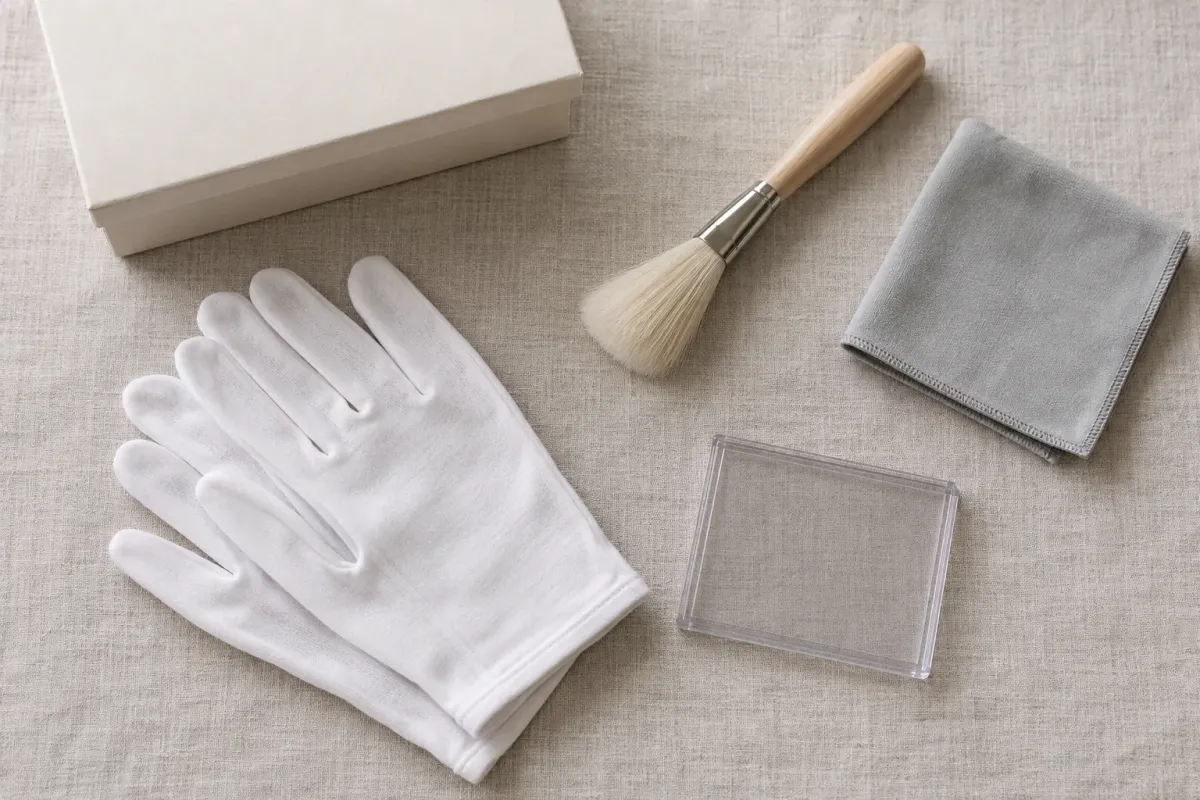
Handle a raw card as little as you can, with clean, dry hands (the archives’ rule for paper), fingers on the edges, over a clear and clean surface with nothing to eat or drink nearby. Sleeve it as soon as it leaves the pack, and from then on hold only the sleeve or the holder. Keep bands, tape and pens off it. Move slabs in sleeves and in a box made for them, never loose in a bag. Gloves are where the guidance splits: archives say clean, dry hands for paper and nitrile gloves for photographs, and a card sits between the two.
Why does handling matter so much?
Because handling wear is part of a grade. CGC’s grading scale allows a TCG card graded 9 just a few small flaws from manufacturing or handling, and a card at 7.5 one moderate flaw or several small handling flaws. Further down, the scale counts writing marks as surface damage. So wear from handling can show up in the grade, and in the condition a seller lists. Our guides to card condition grades and card condition problems show what each kind of wear does.
Bare hands or gloves?
The two main archive sources split their advice by material.
| Source | Paper | Photographs |
|---|---|---|
| National Archives | Clean, dry hands, not cotton or plastic gloves: gloved hands damage paper because gloves tear it, move dirt around faster and make the work clumsy | Nitrile gloves, unless the photograph is already sealed in a polyester sleeve |
| Library of Congress | Clean hands and a clean work area | Clean hands or clean nitrile gloves, which cut dexterity and get dirty; hold prints by their edges |
A trading card is printed card stock, often with a glossy or foil face, so it falls between the two columns.
Clean, dry hands on the edges suit most handling, as the National Archives asks for paper. Its exception for photographs sealed in polyester sleeves follows the same idea as a sleeved card, where the sleeve takes the contact instead of the card. Wash and dry your hands before you start.
What may touch a card, and what never should?
| Item | Verdict | Why |
|---|---|---|
| Clean, dry fingers on the edges | Yes | The National Archives asks for clean, dry hands; the Library of Congress says to hold photographs by the edges |
| A soft sleeve | Yes | It becomes the layer you touch; our storage guide covers sleeve plastics |
| A clean, dry work surface | Yes | The Library of Congress asks for a clean work area; Ultra PRO suggests a breaker mat as a clean place to open packs and sort cards |
| Food and drink | Keep away | The Library of Congress names both |
| Rubber bands and paper clips | Never on a card | The Library of Congress rules out both on paper, and TCGplayer lists rubber bands among packing habits that can damage cards |
| Tape, glue and sticky notes | Never on a card | The Library of Congress rules out adhesives on paper and photographs |
| A pen over the card | Avoid | The Library of Congress says to mark paper in pencil, on a clean, hard surface, so the mark does not press through to the other side; CGC’s scale treats writing as surface damage |
| A brush or canned air on the surface | Take care | For photographs, the Library of Congress warns that even soft brushes can mark the surface, and suggests an air bulb over canned air |
One case looks like an exception. CGC’s packing method for submissions bands two pieces of cardboard around a stack of cards that are each sleeved and in semi-rigid sleeves, and it warns that bands that are too tight can damage the cards. The band never touches a card. Our guide to submitting cards to CGC covers that method.
How do you sleeve a card without damage?
Sleeve early. Ultra PRO calls sleeving cards straight after opening packs one of the easiest ways to keep their condition, and for cards you might grade, it advises handling them as little as possible and sleeving them right away.
Then sleeve gently. TCGplayer’s advice to sellers is to slide the card in by its bottom left corner so the corners do not catch, and to put a sleeved card into a toploader with the sleeve’s opening facing down, so a card that slips out of its sleeve stays inside the holder. Our guide to shipping raw cards covers the rest of that packing.
Taking a card out is where more can go wrong. TCGplayer warns that “perfect fit” sleeves are hard to remove and can lead to damage, so choose a sleeve that fits the card’s size, which our guide to Pokémon card sizes and sleeves sets out. For a grading submission, CGC asks for each card in a sleeve and then a semi-rigid sleeve sturdy enough for its staff to take the card out safely.
How should you handle a slab?
A slab shields the card from fingers, but the holder itself can be marked, cracked or knocked loose.
- Sleeve it. Whatnot asks sellers to put every slab into a sleeve made for graded cards, or a team bag, to keep its surface from being marked.
- Don’t drop it. CGC’s mechanical errors policy, posted in May 2023, covers holder defects. Many of the claims it receives do not qualify because the customer’s packing, storage or handling caused the damage, drops included.
- Stack with care. CGC’s holders lock and stack together. Slabs from different graders differ in size, so our guide to storing graded cards lists which boxes fit which slabs.
- Never open it. CGC’s ReHolder service takes only a card still sealed in its original holder, as our storage guide explains, so an opened slab loses that route.
How do you carry cards to a show?
In a box sized for them, wedged so it cannot slide. BCW’s 30-slab graded box is white corrugated board with a 200 lb test strength, made for long-term storage, transportation and display. For its 400 count box of raw cards, BCW suggests extra protection if the box moves often.
CCI’s guidance on physical forces explains what can go wrong in a vehicle. A package tied down in a vehicle takes shocks roughly like a 15 cm drop. One that is not secured can bounce again and again, or fall from a stack that shifts. The lower packages in a stack carry the weight of those above. So:
- keep stacks short
- wedge the box against a seat or the floor so it cannot slide
- carry binders with side-loading pages or a zip cover, as our guide to building a card binder explains
Heat matters too. Our graded card storage guide covers why a parked car is no place for cards, and our guide to your first card show covers the day itself.
A handling routine
- Clear and wipe the table, with no food or drink nearby.
- Wash and dry your hands.
- Hold each card by its edges.
- Sleeve it right away, corner first.
- Label boxes, dividers or holders rather than a sleeve with the card inside.
- Move slabs sleeved and boxed, and wedge the box in the car.
For cards you want on show, see how to display trading cards.
Frequently asked questions
What tape is safe for sealing a toploader?
Painter's tape, not clear Scotch tape. Whatnot asks sellers to seal toploaders with painter's tape, and the tape goes on the holder, never on the card.
Should I trim a thick penny sleeve before using it?
Yes. Whatnot asks sellers to trim the corner of a thick penny sleeve before the card goes in, so the sleeve doesn't catch and damage the card's corners.
How do I close a magnetic holder without marking the card?
Use a holder sized to the card's thickness, and lay a penny sleeve over the front of the card before the holder closes. Whatnot asks its sellers to pack magnetic holders the same way.
Who is responsible for cards on the way to CGC?
The sender. The shipping provider you pick when you submit an order covers only the return trip from CGC to you, so getting them there safely is up to you.