How to build a card binder: pages and capacity
Which pocket pages fit which cards, side-loading or top-loading, ring albums or zip folios, and how many cards each binder holds.
By the Rip.fan Editorial Team.
Published 6 min read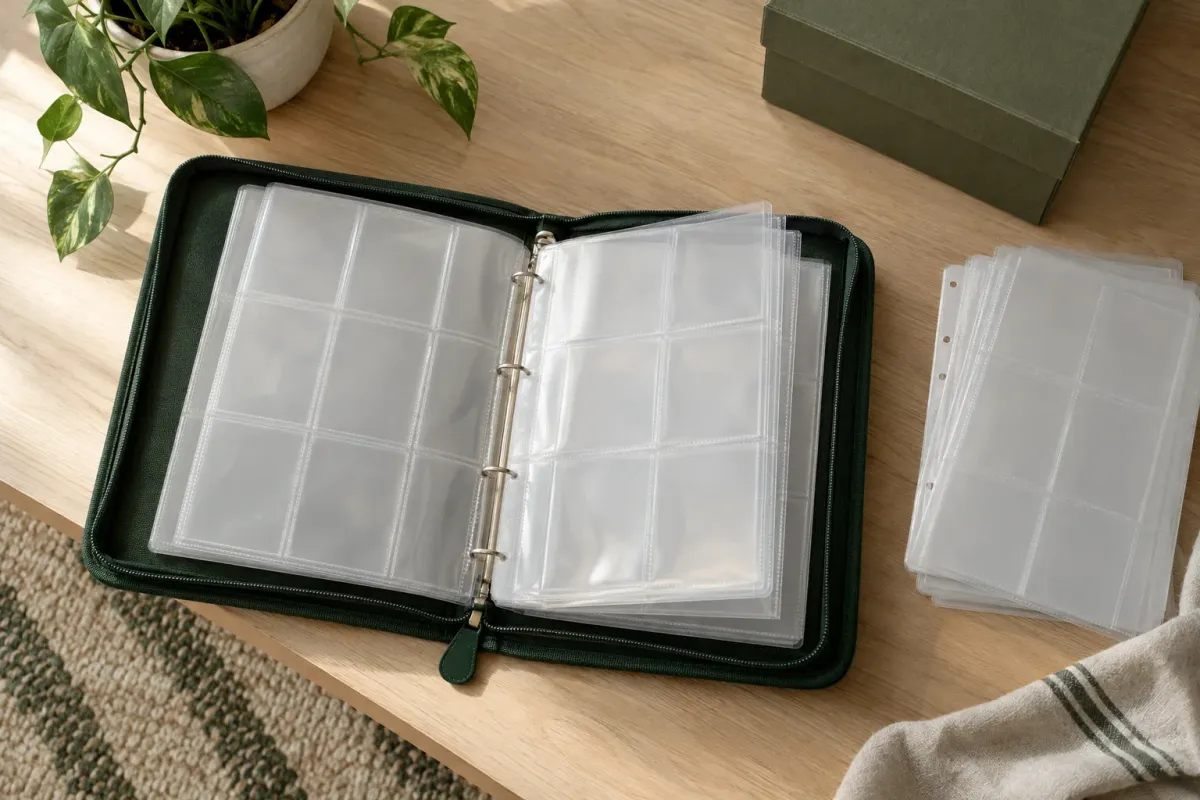
A card binder comes down to three choices: the pages, the cover and how full you fill it. For standard cards, use 9-pocket polypropylene pages, side-loading if the binder will travel, and sleeve each card first. Then fill the rings only to the lower of the makers’ page counts. BCW rates its 2-inch D-ring album for up to 60 pages and its 3-inch album for up to 90, while Ultra PRO advises no more than 50 pages on its 2-inch rings and no more than 18 cards a page. A zip folio comes with a stated count: 360 cards in BCW’s 9-pocket Z-Folio and 480 in its 12-pocket one.
To decide what goes in which binder, start with our guide to organizing a card collection.
Which pages fit which cards?
Pages differ by pocket count, pocket size and which side the card goes in.
| Page | Cards a page | What it holds |
|---|---|---|
| 9-pocket, top-loading | 9 | Standard cards up to 2 1/2 by 3 1/2 inches, in BCW’s LaserWeld page |
| 9-pocket, side-loading | 9 | Standard cards, with the opening on the side |
| 18-pocket, side-loading | 18 (9 a side) | BCW’s double-sided Pro pages, with pockets of 2 5/8 by 3 3/4 inches |
| 12-pocket | 24 (12 a side) | Standard cards, in BCW’s 12-pocket Z-Folio |
| 4-pocket | 8 (4 a side) in BCW’s folio | Ultra PRO also lists 4-pocket pages for toploaders and for ONE-TOUCH holders from 23pt to 100pt |
| 6-pocket tall | 6 | Tall cards; BCW names 1965 Topps football and Star Wars Widevision |
| 8-pocket vintage | 8 | Vintage sports cards; BCW names Bowman and Topps from 1948 to 1985 |
| Slab pages | Varies | Ultra PRO lists a page for PSA slabs and a 4-pocket page for Beckett slabs |
Card sizes differ between card games, so match the pocket to the card. Our guides to Pokémon card sizes and sleeves and card sizes for other card games give the measurements.
Top-loading or side-loading?
A top-loading pocket opens along its top edge, as on BCW’s LaserWeld 9-pocket page. A side-loading pocket opens along one side. Ultra PRO recommends side-loading 9-pocket pages for Pokémon cards and calls them especially useful for valuable collections, because they help keep cards from slipping out when the binder moves. BCW’s side-loading pockets deter cards from sliding out of place.
One detail looks like a flaw but isn’t. Ultra PRO cuts the front and back sheets of a page to slightly different lengths. Sheets cut to the same length could stick together during manufacturing, which would make the top pocket harder to open.
How many cards does a binder hold?
Makers give capacity in two ways: a stated count for a folio, or a page limit for a ring album. Where a maker gives only pages, the card count below is Rip.fan’s arithmetic, assuming one standard card in every pocket of a 9-pocket page.
| Binder | Pages | Cards, by the maker | Cards, by Rip.fan’s arithmetic |
|---|---|---|---|
| BCW Card Folio, 4-pocket | 20 double-sided | At least 160 | 160 |
| BCW Z-Folio, 9-pocket | 20 double-sided | 360 | 360 |
| BCW Z-Folio, 12-pocket | 20 double-sided | 480 | 480 |
| BCW Z-Folio for toploaders | 14 double-sided | 252 toploaders | 252 |
| Ultra PRO 3-inch album, 2-inch rings | No more than 50 | No more than 18 a page | Up to 900 |
BCW’s 2-inch D-ring album takes up to 60 pages, or 540 cards by Rip.fan’s arithmetic, and its 3-inch D-ring album takes up to 90 LaserWeld pages, or 810 cards by Rip.fan’s arithmetic.
Our sleeve and supplies finder counts the pages and albums for any number of cards, at 9 or 18 cards a page.
Why do the makers’ limits differ?
For a 2-inch ring, BCW’s page count is higher than Ultra PRO’s advice: 60 pages against 50. The 2-inch in BCW’s album name is the size of the D-rings, and Ultra PRO’s 3-inch albums use 2-inch rings, so the two figures cover the same ring size on different products. Only Ultra PRO gives a reason for its limit: too many pages, or pages holding too many cards, bow or bend and can damage what is inside.
Fill to the lower figure unless your own album’s maker says otherwise. Sleeves are no barrier to that: BCW’s Z-Folio pages protect cards held in soft sleeves and even double sleeves.
Ring album or bound folio?
The two covers suit different jobs.
| Ring album | Bound or zip folio | |
|---|---|---|
| Adding pages | Yes; Ultra PRO’s albums have three rings for adding or removing pages, and BCW’s D-rings let you rearrange them | Not in Ultra PRO’s PRO-Binders and Eclipse binders, which are bound like a book; BCW’s folios list a set page count |
| Capacity | Set by ring size and the maker’s page limit | Stated by the maker: 20 pages in most of BCW’s folios, 14 in its toploader folio |
| Best for | A growing set or a collection you reorder | A finished set, or a binder that travels |
Bound folios close up for carrying. BCW’s Z-Folios have a wrap-around zipper, and its 9-pocket Card Folio an elastic band.
Ultra PRO suggests keeping a separate binder for trades and the permanent collection in archival binders, so the cards you show and swap are not the ones you keep. Our guide to trading cards covers the swap itself.
What should the pages be made of?
Polypropylene, the material of the makers’ archival ranges. Ultra PRO’s binder pages are archival-safe, non-PVC polypropylene, and BCW’s LaserWeld pages are 115-micron, acid-free polypropylene. But BCW also sells 9-pocket pages made of heavy-duty clear vinyl, and Ultra PRO uses vinyl as another name for PVC, so read the material line on any listing. Our guide to storing trading cards explains why archive guidance steers clear of PVC.
Thickness varies between ranges too:
| Ultra PRO pages | Front | Back |
|---|---|---|
| Photo | 90 microns | 60 microns |
| Silver and Anti-Microbial | 90 microns | 90 microns |
| Platinum | 115 microns | 90 microns |
Pages not on this list are most likely Photo or Silver thickness.
What about thick cards, toploaders and slabs?
Standard pockets are for standard cards. Ultra PRO advises against cards thicker than 55pt in its 9-pocket pages and suggests its 4-pocket toploader pages instead. For a card already in a rigid holder, it lists 4-pocket pages for toploaders and for ONE-TOUCH holders, and pages for some graded slabs. BCW’s toploader Z-Folio holds 252 toploaders on 14 double-sided pages. A toploader in a binder page lets you see the card while keeping it rigid.
How do you fill a binder?
- Sort first. Put a set in card number order. Rip.fan’s Pokémon card prices give each set its own table, which works as a checklist, and our guide to completing a Pokémon set covers tracking one.
- Sleeve each card. Ultra PRO advises sleeving cards before they go into binder pages, and suggests sleeving straight after opening packs.
- Leave gaps on purpose. Keep an empty pocket for each card a set is missing, so the order holds as it fills.
- Stay under the page count. Count pages against your maker’s figure, and use the lower one if you are unsure.
- Store it closed. A shut binder keeps light off the cards; our guide to displaying trading cards covers what changes when cards are on show, and handling cards safely covers moving cards in and out.
Frequently asked questions
Why do BCW's LaserWeld pages lie flat?
BCW's patented laser-welded seams are built so the pages lie flat, which helps keep them from warping.
What size sleeve fits a Pokémon card before it goes in a page?
A standard-size sleeve of 66 by 91 mm, the size Ultra PRO gives for Pokémon cards. Ultra PRO adds that double-sleeving gives extra protection against edge wear and moisture.
Why can't a thick card go in a 9-pocket page?
Because Ultra PRO's 9-pocket pockets have no gusset to expand, a card thicker than 55pt presses against the pocket and its corners and edges can be damaged.