How to ship raw cards: envelopes and mailers
How to pack a raw card, when a plain envelope is enough, and the value lines where TCGplayer, eBay and Whatnot want tracking or a signature, with USPS prices.
By the Rip.fan Editorial Team.
Published 7 min read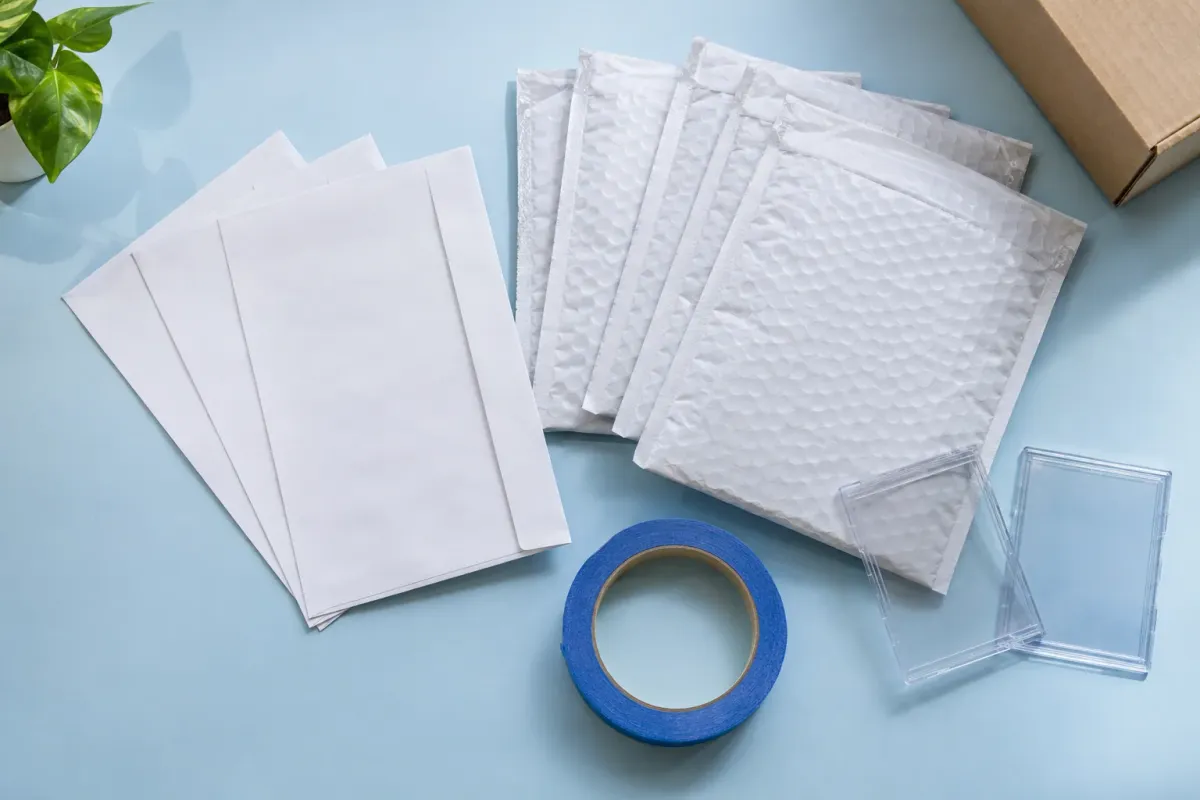
To ship a raw card, put it in a soft sleeve, then a toploader, and seal it in a team bag so it can’t slide out. A card worth $20 or less can travel cheaply in a flexible paper envelope through eBay’s standard envelope or Whatnot’s First-Class Mail letter option, which both stop at $20 and add basic tracking, though a stiff holder can break their envelope rules. Above that, send it as a parcel in a bubble mailer with tracking. TCGplayer advises tracking on orders over $20, requires it over $49.99 and requires signature confirmation over $250. The USPS prices below took effect on October 4, 2026.
How do you pack a raw card?
- A soft sleeve first. Whatnot recommends a penny sleeve for every card. TCGplayer suggests sliding the card in by its bottom left corner so the corners don’t catch on the sleeve. For a thick card, Whatnot says to trim the corner of a thick penny sleeve before the card goes in.
- Then a rigid holder. TCGplayer highly recommends a toploader, and Whatnot requires a properly sized one for high-value cards. Put the card in with the sleeve’s opening facing down, TCGplayer advises, so a card that slips out of its sleeve stays inside the holder. Two pieces of stiff cardboard pressed tight around the card also work. On Whatnot, a magnetic case must fit the card and gets a penny sleeve over the front before it closes.
- Stop it sliding. TCGplayer prefers a team bag, the clear resealable kind, around the holder, and Whatnot requires one for every raw card. The two disagree on tape. TCGplayer says clear tape over the top of the toploader works, while Whatnot calls for painter’s tape and not clear office tape. TCGplayer adds that the buyer has to get the card out without damaging it, so use as little tape as will hold.
- The outer layer. TCGplayer suggests a bubble mailer or a secure envelope from an office supply store. Whatnot asks for a bubble mailer or padded packaging, with cardboard inserts or padding where needed and no empty space for the card to move in. TCGplayer’s firm rule: never mail a card in an envelope with no protection at all.
Our guide to storing trading cards covers sleeve and toploader sizes.
What does USPS charge for an envelope or a mailer?
A raw card can go as a letter or as a parcel. USPS decides which by the piece’s size, thickness, stiffness and weight, and a lumpy or uneven fill can count against a letter.
A letter must be 5 to 11-1/2 inches long, 3-1/2 to 6-1/8 inches high, no more than 1/4 inch thick and no heavier than 3.5 oz. A stamped letter costs $0.82 for 1 oz, $1.11 for 2 oz, $1.40 for 3 oz and $1.69 for 3.5 oz.
A nonmachinable letter costs $0.49 more. The surcharge applies to a letter that is too rigid, meaning one that does not bend easily under 40 pounds of belt tension around an 11-inch turn. It also applies to letters with clasps or strings, a plastic outer surface, lumpy contents, an address running along the short side, or a length divided by height outside 1.3 to 2.5. Unusual envelopes cost $1.31 and up.
A large envelope starts at $1.69, but one that is rigid or not evenly thick pays parcel prices instead.
A parcel by USPS Ground Advantage starts at $8.40 at a Post Office, for up to 4 oz to the nearest zone, and rises to $10.20 for the farthest. USPS’s commercial price for the same 4 oz parcel runs from $7.33 to $8.95. Tracking and $100 of insurance are included, and delivery is expected in 2 to 5 days.
Our shipping cost estimator prices a letter, a mailer or a box from the same price list, with the tracking and insurance each one comes with.
| Way to send one card | Postage | Tracking | Value limit or cover | Packaging allowed |
|---|---|---|---|---|
| eBay standard envelope | eBay’s current rate; see below | Yes, through eBay | Item price up to $20, before tax | Flexible envelope under 1/4 inch; no bubble mailers or cardboard packages |
| Whatnot First-Class Mail letter | $0.78 to 1 oz, $1.09 to 2 oz, $1.39 to 3 oz (as of July 31, 2026) | Limited, inside Whatnot only | Whole shipment up to $20, 5 items, 3 oz | Flexible paper envelope; no stiff inserts |
| USPS Ground Advantage parcel | From $8.40 retail, $7.33 commercial | Yes, plus $100 insurance | Extra insurance up to $5,000 | Bubble mailer or box |
A stamped USPS letter costs $0.82 at 1 oz, or $1.31 if nonmachinable, and includes no tracking. It takes a flexible paper envelope of even thickness.
At exactly $20, eBay gives two answers: up to $20 before tax, or less than $20. Check eBay’s current envelope rate before you count on it.
Can a toploader go in a plain envelope?
This is where the rules differ most.
- USPS charges the nonmachinable surcharge on a letter that does not bend easily, and charges parcel prices for a rigid large envelope.
- TCGplayer allows either a padded mailer or a sturdy envelope, but warns that an envelope over 1/4 inch thick, or one too bulky, rigid or unevenly thick, can be charged a surcharge or a parcel rate. One of its own examples is an envelope whose two toploaders slid to one side, which made it unevenly thick.
- Whatnot bars rigid cardboard and stiff inserts that do not bend from its letter option, and says letters that fail USPS rules may be refused, returned, delayed or charged more.
- eBay requires a standard envelope that is evenly thick, under 1/4 inch and not too rigid, and does not take cardboard packages. It adds that if you need a thicker or stiffer envelope, you should ask your local postmaster, because practice varies by region.
The practical rule: if the envelope will not bend, pay for a nonmachinable letter or send it as a parcel. If it goes as a letter, fix the holder in the middle of the envelope so the thickness stays even.
When does a card need tracking or a signature?
The marketplaces draw their lines at similar values.
| Marketplace | Envelope service | Tracking and signature |
|---|---|---|
| TCGplayer | Not covered; its missing-order protection needs a carrier linked to its Seller Portal | Advised over $20, required over $49.99; signature confirmation required over $250 |
| eBay | Standard envelope, for items up to $20 in supported categories, with loss or damage protection up to $20 an item and $50 a shipment | Raw and graded cards over $250 go through Authenticity Guarantee, with signature confirmation asked on cards over $750 |
| Whatnot | First-Class Mail letter, for live-show sales of trading cards, sports cards or stickers, up to $20, 5 items and 3 oz | Shipments that stop qualifying move automatically to Ground Advantage or Priority Mail |
Two more conditions matter. On TCGplayer, a seller who skips required tracking or a signature gives up the right to contest a buyer’s claim that the order never arrived. And Whatnot’s letter option is slower: delivery usually takes 2 to 10 business days, its tracking shows only inside Whatnot, and the money from the sale starts processing 10 days after the label is made, unless the seller picks the faster option that starts processing when the label is made.
Which way suits which card?
The card values are made up, and each card ships alone within the US.
| Card value | Where it sold | How to send it | Postage |
|---|---|---|---|
| $6 | A Whatnot live show | Whatnot letter, card in a sleeve and team bag, flexible envelope | $0.78 up to 1 oz |
| $15 | eBay | eBay standard envelope, if the category is supported | eBay’s current envelope rate |
| $40 | TCGplayer | Bubble mailer by Ground Advantage, since TCGplayer advises tracking over $20 | From $8.40 at a Post Office |
| $300 | TCGplayer | Bubble mailer by Ground Advantage with Signature Confirmation, plus insurance above the included $100 | From $8.40, plus $5.15 for the signature at retail or $4.15 electronic |
For a card worth more than a few hundred dollars, the insurance and claim rules start to matter more than postage. Our guide to shipping a graded card yourself prices USPS insurance by value and lists what a claim needs.
What proof should you keep?
On Whatnot, scan a letter at drop-off with the in-app scanner. The scan sends the buyer a photo of the envelope and creates proof of shipment, which matters when tracking is thin. On TCGplayer, use a carrier linked to its Seller Portal (USPS, UPS or FedEx), since its missing-order protection depends on it. Everywhere, keep the sale record and photos of the card until the buyer has it. Our guide on how to photograph cards to sell covers the photos, and where to sell cards online compares each site’s fees.
Frequently asked questions
Do Forever stamps cover a card envelope after prices rise?
Yes. A Forever stamp is always valued at the 1 oz First-Class Mail stamped letter price in force when you mail it, whenever it was bought. USPS also sells Forever stamps for the additional ounce and for the nonmachinable surcharge, each valued at that price on the day you use it.
What size envelope does eBay's standard envelope take?
One from 3.5 by 5 inches up to 6.125 by 11.5 inches, weighing no more than 3 oz with the card inside, and not made of plastic, under eBay's terms on October 27, 2026. Each label is good for 7 days after you buy it.
How do you claim for a lost eBay standard envelope?
File through eBay within 90 days of creating the label, but not sooner than 15 days for a lost envelope. An approved claim is paid within 7 business days of the paperwork arriving, and a damaged card that is paid for may have to be sent back.
Is a Padded Flat Rate Envelope the same price as the plain one?
No, the padded one costs more, and both say Flat Rate Envelope in large print, with Padded only in small text by the barcode. Paying for the plain envelope and sending the padded one brings postage due for the difference.