How to ship a large card order in one box or more
Box-in-box packing for many cards or slabs, USPS and FedEx size and cover limits, when to split an order, and TCGplayer's and Whatnot's rules for big orders.
By the Rip.fan Editorial Team.
Published 9 min read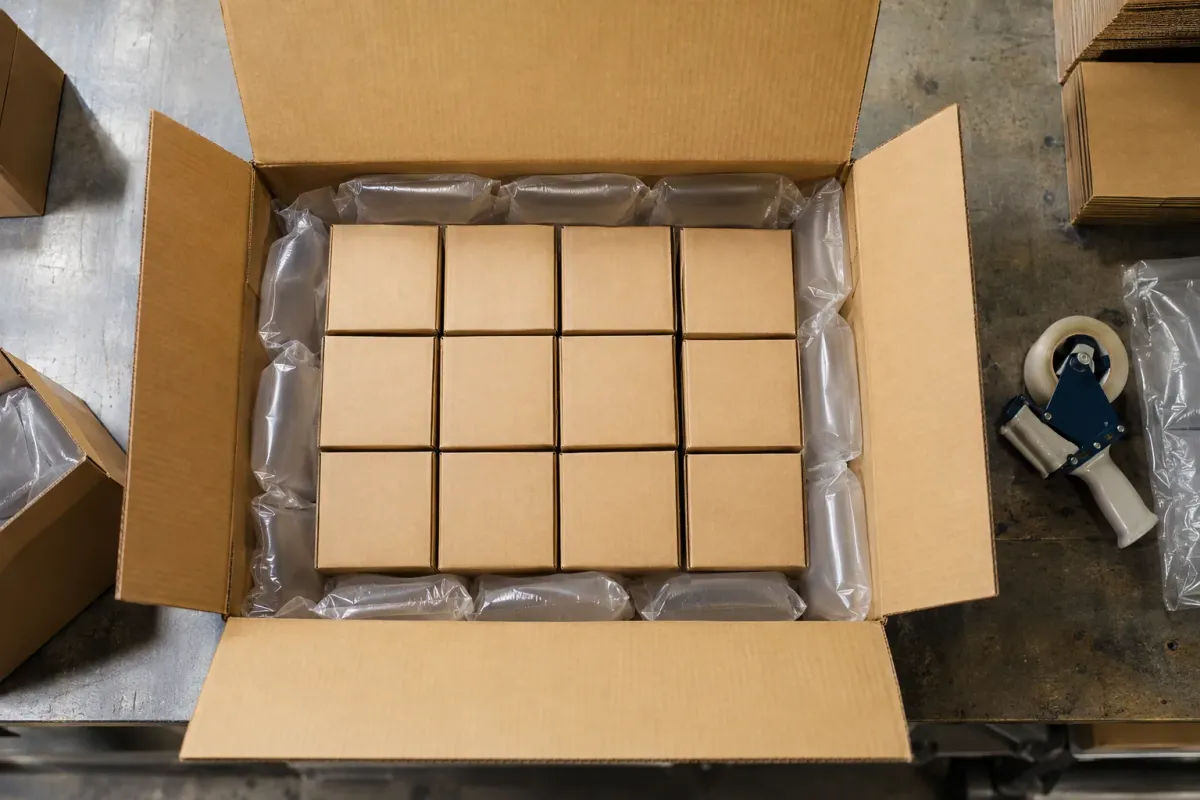
Ship a large order as boxes inside a box. Group the cards first, raw cards in numbered team bags or a filled count box and each slab in its own sleeve inside a slab box, then set those snug inner boxes in a sturdy carton with 2 to 3 inches of cushioning on every side. Before you buy postage, check the order’s value against each carrier’s limit for one package. USPS insured mail stops at $5,000 a box and Registered Mail at $50,000, and Whatnot’s shipping protection stops at $10,000 a shipment, so above a limit you either change the service or split the order. A big, light box may also be billed by its size. USPS prices here are those in effect from October 4, 2026.
For a single card, see our guides to shipping raw cards and shipping a graded card yourself.
How do you pack many cards in one box?
In layers, so that nothing can move at any level. TCGplayer’s rules for sellers sending stock to its Authentication Center are a good model, because they deal with exactly this:
- Bag and number. Seal cards in team bags and number the bags in the order of the packing slip.
- Avoid sending a storage box on its own. TCGplayer does not recommend shipping BCW-style card boxes alone: they are not made for shipping or rough handling and belong inside a mailer or a larger box.
- Stop movement inside and out. The cards should have no room to flex inside their small boxes, and the small boxes no room to slide inside the shipping box.
- Use the right fillers. TCGplayer accepts foam pads, air cushions, bubble wrap and packing peanuts.
For slabs, Whatnot asks for each one in a sleeve made for graded cards, or a team bag. A slab box keeps them together; BCW describes its 30-slab box as corrugated board with a 200 lb test strength. On Whatnot, sealed wax, meaning sealed product, must go in a box, not a bubble mailer.
Then the outer carton. FedEx asks for 2 to 3 inches of cushioning on all six sides, and Whatnot for about 2 inches on each side. Paperboard or corrugated boxes are best for loads up to 10 pounds, and double-walled boxes for heavier items. Shake the sealed box gently. It should not move much, and if you hear anything shift, add cushioning.
Why 2 inches of cushioning?
The Canadian Conservation Institute (CCI) reproduces an industry table of how far packages are likely to fall in shipping, by weight. In that table the lightest class, listed as 10 kg (about 22 pounds by Rip.fan’s conversion), is a one-person throw, with a probable drop of 100 cm. The next class, 10 to 20 kg, is a one-person carry, with a probable drop of 90 cm. CCI calls these a reasonable worst case that is seldom passed.
Its next table shows what cushioning does to a 90 cm drop onto a hard floor:
| Packing | Shock (g) |
|---|---|
| Carton | 113 |
| 25 mm (about 1 inch) of cushioning | 85 |
| 50 mm (about 2 inches) of cushioning | 45 |
Going from 1 inch to 2 inches of cushioning roughly halves the shock, which fits the 2 inches Whatnot asks for and the 2 to 3 inches FedEx asks for.
Does a Flat Rate box leave room for that?
Not around a slab box. Rip.fan worked out the fit from BCW’s outside measurements and USPS’s inside ones:
| Inner box | Flat Rate Box | Space on each side (length, width, height) |
|---|---|---|
| BCW 30-slab box, 8 7/8 by 5 3/4 by 3 5/8 in, laid on its side | Medium, top-loading, 11 by 8 1/2 by 5 1/2 in | About 1 1/16, 1 3/8 and 15/16 in |
| BCW 30-slab box, laid on its side | Large, 12 by 11 3/4 by 5 1/2 in | About 1 9/16, 3 and 15/16 in |
| BCW 400 count box, 7 7/8 by 4 1/8 by 3 in | Medium, top-loading | About 1 9/16, 2 3/16 and 1 1/4 in |
The slab box is 5 3/4 inches tall standing up, more than either Flat Rate Box’s 5 1/2 inches, so it has to lie on its side. In both slab box rows the height is the tight side, at under an inch above and below. The 400 count box has a little more room, but still under 2 inches above, below and at each end. A Flat Rate box costs the same whatever it weighs, up to 70 pounds: $25.80 for the Medium and $36.10 for the Large at retail, or $22.02 and $32.75 at commercial prices. A plain box, priced by weight and size, leaves room for full cushioning.
How much does one box cost to cover?
The cover limit applies to each package, which is what makes the size of an order matter.
| Carrier or marketplace | What one package or shipment can carry |
|---|---|
| USPS Priority Mail and Ground Advantage | Up to $100 of insurance included |
| USPS insured mail | Up to $5,000 per package |
| USPS Registered Mail | Up to $50,000, handed to a postal employee |
| FedEx | $100 of liability included; declared value is not insurance |
| Whatnot shipping protection | Up to $10,000 a shipment, at 1% of item value plus shipping on US domestic packages |
When is splitting the order cheaper?
Rarely, on USPS’s fees. These are the fees alone, from the October 4, 2026 price list. Each extra box also needs its own postage.
| Order value | One box, insured | One box, Registered Mail | Two boxes, each insured for half |
|---|---|---|---|
| $2,000 | $30.05 | $31.20 | $30.10 |
| $5,000 | $75.05 | $40.50 | $75.10 |
| $8,000 | Not available above $5,000 | $49.80 | $120.10 |
The $8,000 Registered Mail fee is Rip.fan’s arithmetic from the price list: $40.50, plus $3.10 for each $1,000 or part of $1,000 above $5,000, which is three steps. The same count reaches exactly $180.00 at $50,000, the list’s flat fee for anything over that, so the steps do run from $5,000. Registered Mail costs less than insuring two boxes at $5,000 and about the same at $2,000.
Our shipping cost estimator works out the insurance and Registered Mail fees at the order value you enter, and the split across packages once an order passes $5,000.
Registered Mail has conditions of its own. USPS’s mail manual refuses it for padded envelopes, plastic or spun-bonded mailers and glossy paper mailers. The box must be sealed with glue or plain paper or cloth tape that visibly damages the wrapper if removed and takes a postmark’s ink, and postal staff may not help you seal it. You must also tell the clerk if the contents are fragile and describe the packing.
FedEx adds a rule for orders split across several packages. A package declared at $500 or more gets Direct Signature Required at no extra charge, and if one package in a multi-package shipment reaches $500, the signature applies to the whole shipment, with the signature fee charged only on packages under $500. FedEx also sets maximum declared values for certain kinds of items, and our graded card shipping guide covers how that applies to cards.
Whatnot gives three ways past its $10,000 limit: split the order into shipments under $10,000 each, buy your own insurance and send Whatnot proof, or rely on its High Value Loss Reimbursement Policy for the value above $10,000.
Why does a big, light box cost so much?
Dimensional weight. For Priority Mail and Ground Advantage parcels over 1,728 cubic inches, one cubic foot, USPS charges whichever is greater: the actual weight or the dimensional weight. To find it, round each side up to the nearest inch, multiply length by width by height, divide by 139 and round up. A 14 by 12 by 12 inch box comes to 2,016 cubic inches, so it is billed as at least 15 pounds even if the cards inside weigh 6 pounds.
Size adds fees too. On Priority Mail at retail, USPS adds $4.50 for a parcel over 22 inches long and up to 30, $21.00 over 30 inches and $35.00 over 2 cubic feet. No mailpiece may top 70 pounds, or 108 inches of length plus girth, except Ground Advantage Retail, which allows 130 inches.
Don’t save by switching to Media Mail. TCGplayer gives the example of a box of cards sent by Media Mail, opened by USPS and charged postage due, and Whatnot offers Media Mail only for records, CDs, cassettes, movies and books.
How do TCGplayer and Whatnot handle big orders?
| TCGplayer | Whatnot | |
|---|---|---|
| How a big order ships | A store ships everything a buyer orders from it in one package | Smart Bundling groups a buyer’s purchases by weight, size and carrier price, and may split them into several shipments |
| What scales with value | Tracking over $49.99 and signature confirmation over $250, judged on the order’s value | A signature added automatically to certain US shipments of $500 or more in order value; protection up to $10,000 |
| What to watch | Skipping a required signature costs the seller the right to contest a buyer’s claim that the order never arrived | Each box must match the grouping shown in Seller Hub, or tracking and the seller’s payment can stall |
On Whatnot, you can unbundle items too big, heavy or fragile to travel together, and each split shipment then gets its own label and tracking number.
What else goes in the box?
- A second address. USPS suggests an extra label with both addresses inside, and FedEx a copy of the label plus the sender’s and recipient’s details on the inner flap.
- A packing list. Number the team bags to match it, as TCGplayer asks of sellers sending stock to its Authentication Center, so each bag can be checked in order.
- Strong tape, applied the H way. FedEx gives two minimum widths for the tape, 3 inches and 2 inches. USPS asks for 2-inch tape and no string, masking or cellophane tape.
FedEx also suggests discreet packaging for high-value items. For a batch going to a grader, see submitting cards to CGC; for selling a whole collection, see how to sell a card collection. Base any declared value on sold prices, as how to find what a card sold for explains.
Frequently asked questions
Do Flat Rate boxes pay USPS's oversize fees?
No. USPS Flat Rate packaging is exempt from all of its nonstandard fees, the charges for long, bulky or odd-shaped parcels. A plain box sent with wrong measurements, or without paying a dimensional weight price that applies, is charged a dimension-noncompliance fee instead.
Can USPS collect a large card order from home?
Yes. Priority Mail and Priority Mail Express include free Package Pickup at your home or office, and Priority Mail adds no surcharge for fuel, residential or rural delivery, or Saturday delivery. Without a printer, USPS will print and deliver a Click-N-Ship label for $1.65, as of October 27, 2026.
Can a Flat Rate label go on your own box?
No. USPS honors Flat Rate only on packaging marked Flat Rate, so a plain box is repriced by weight and distance, with the difference charged as postage due. Postage due is figured at retail prices even when the label was bought at commercial prices.