How to grade Pokémon cards: CGC, SGC and TAG compared
Which Pokémon cards CGC, SGC and TAG accept, from Japanese cards to promos, jumbo and error cards, which service fits each card, and what each label shows.
By the Rip.fan Editorial Team.
Published 7 min read
Grading a Pokémon card starts with one check: does the grader take that kind of card? CGC grades cards in every language and grades error cards under its own service. TAG takes only English, Japanese and Chinese Pokémon cards in the standard size, and turns away jumbo cards, metal cards and miscuts. SGC lets customers submit any trading card (while reserving the right to decline an item) and prices cards above 3-1/2 by 5-1/2 inches separately, as oversized. Once the card qualifies, the service follows from its declared value and how many cards you send.
Which Pokémon cards does each grader take?
The table compares CGC and TAG.
| Card | CGC | TAG |
|---|---|---|
| English card, standard size | Yes | Yes |
| Japanese card | Yes, all languages | Yes |
| Chinese card | Yes | Yes, since September 25, 2025 |
| Korean, French, German or other language | Yes | No |
| Standard-size promo, out of its wrapper | Yes | Yes |
| Jumbo card | A $20 Jumbo Card level (see below) | No |
| Error or miscut card | Yes, under the Error service, no extra fee | No |
| Card signed by its artist | Yes, with optional JSA autograph authentication | No |
| Funskool-brand Pokémon card | No | No |
A few rows need more detail:
- Chinese cards at TAG. TAG accepts Chinese-language Pokémon cards, Traditional and Simplified, but its list of ineligible releases still names every language outside English and Japanese. Confirm with TAG before sending Chinese cards.
- Jumbo cards at CGC. CGC limits cards to 2-5/8 by 3-3/4 inches and 7.25mm thick, yet it also offers a Jumbo Card level at $20 a card, with an estimated 120 working days, so ask CGC first.
- Stamped promos. CGC does not grade unofficially stamped cards. A stamp the maker printed is not an unofficial one, so it should not bar the card. TAG takes only cards distributed through official channels.
- Square-cut cards. CGC usually grades square-cut Pokémon cards from after the Wizards of the Coast era. From the Wizards era itself, only Neo Genesis holofoils go through without extra documentation; other cards need provenance tracing back to a Wizards employee.
- Altered cards. TAG sends trimmed or altered cards back unslabbed, and SGC will not grade them. CGC gives two answers: it refuses a numeric grade to any altered card, artist alterations included, yet also says it grades artist and artistic alterations. Ask CGC how it will label an altered card before you pay.
Which service fits which card?
Each grader prices differently. CGC and SGC set the fee by the card’s declared value, so a higher-value card moves up a level. TAG charges one price per service level with no value tiers; the level sets the speed, the report and the built-in cover for the card while TAG has it.
| Declared value of one card | CGC’s lowest-priced level | SGC’s lowest-priced level |
|---|---|---|
| Up to $500, in an order of 25 or more | Bulk, $17, about 150 working days | Standard, $50, 40 or more business days |
| Up to $1,000 | Economy, $20, about 90 working days | Standard, $50 |
| Up to $1,500 | Standard, $55, about 10 working days | Standard, $50 |
| Up to $3,000 | Standard, $55 | Standard, $85 |
| Up to $10,000 | Express, $100, about 5 working days | Expedited, $500 (its $250 level stops at $7,500) |
SGC’s figures are as of October 12, 2026. Its fast Expedited levels, 2 to 3 business days, start at $150 for cards up to $3,500. CGC’s turnaround figures are estimates, and its paid memberships take 10% (Associate and Premium) or 20% (Elite) off grading.
TAG has four priced levels, as of September 30, 2026:
- STANDARD, $59.95 a card: an estimated 45 business days, with built-in cover up to $1,000 a card.
- PRIORITY, $79.95: about 30 business days and cover up to $1,500.
- EXPRESS, $149.95: about 10 business days and cover up to $2,500.
- PREMIER, $299.95: about 3 to 5 business days and cover up to $5,000.
TAG also has a BASE level, at about 60 business days with cover capped at $500 a card. TAG’s cover applies once a card reaches TAG, and extra cover can be bought at $2,500, $5,000 and $10,000. That makes the cap the number to watch: for a card worth more than its level’s cover, the add-on is how to raise it. TAG does not currently offer a bulk discount to the public.
Our grading cost calculator picks the cheapest and fastest CGC and SGC level for any declared value and card count. Whether the fee is worth paying at all is the subject of our guide to whether a card is worth grading.
How do the grading scales treat a Pokémon card?
- CGC tops its scale with a Pristine 10, for a card that is flawless under 10-times magnification with 50/50 centering, and gives it a gold label. A Gem Mint 10 allows centering up to about 55/45 on the front and 75/25 on the back. From 9 down to 4.5, CGC states centering limits for sports and non-sports cards only; for TCG cards it describes handling and manufacturing flaws at the grades from 9 to 7.5 instead.
- SGC has two 10s, 10 PRI (Pristine) and 10 GM, then half grades down to 1. It describes 10 PRI as virtually flawless with 50/50 centering.
- TAG places a Pristine 10 above Gem Mint 10 and has no 9.5. For a Pristine 10, front centering generally cannot exceed 51/49 on any single measurement, and back centering 52/48 on TCG cards, against 54.5/45.5 on sports and other non-TCG cards.
Enter a card’s border widths in the centering checker to see its centering split and the highest CGC and SGC grades whose published figures it meets, and our guide to checking a card before grading covers corners, edges and surface.
What does each label show?
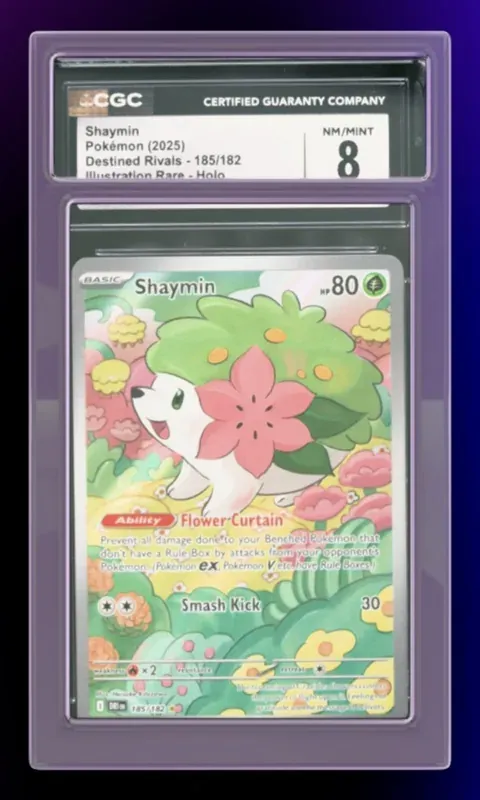
- CGC prints a detailed card description, the grade, and a cert number and barcode unique to the card, with microprinting, UV ink and holographic foil against copying. A QR code on the back of the label opens the card’s images on CGC’s website. Two extras can appear: a pedigree, for $5 a card, and an “Inadvertent Early Release” designation for cards that reached the public before their release date. CGC’s example is the 2021 French McDonald’s Pokémon promos that people reported finding in a Vivid Voltage product released in November 2020; such cards must reach CGC at least 30 days before the official release. The holder measures about 3.15 by 5.30 inches. Our guide to reading a CGC label decodes the grade names.
- SGC shows the grade from its own scale, including 10 PRI or 10 GM, with a cert code. Its cert lookup asks for all 7 digits on a black label and all 11 characters on a green or white one. Its holder has a black insert inside, and custom cuts to it can cost extra. Our guide to reading an SGC label maps the rest of the layout.
- TAG puts a QR code on every slab that opens its DIG report online. From the STANDARD level up, the report includes a TAG Score out of 1,000, and the PREMIER level adds the fuller DIG+ report, with subscores out of 1,000 for front and back centering, corners, edges and surface. Its standard slab measures 5.25 by 3.125 inches. Our guide to TAG grading covers the report in full.
How should you get a Pokémon card ready?
- Take promos out of their wrappers for TAG. It asks for each card in a penny sleeve and semi-rigid holder.
- Send errors to CGC under its Error service. TAG refuses miscuts and misprints, including square-corner miscuts.
- Send TAG no slabs. It has no crossover service and takes cards only in a penny sleeve and semi-rigid holder; an order holding another company’s slab is delayed and may cost extra. CGC does cross cards over from PSA, Beckett and SGC holders, and treats Beckett BCCG cards as raw.
- Describe rare Japanese cards and promos fully. CGC warns that a card not yet in its database can take longer, and TAG lets you enter a card by hand, with the maker, subject and card number, when its database lacks it.
Our guides to packing cards for grading, submitting to CGC and submitting to SGC walk through each order, and card grading mistakes lists the slips that cost money. Once a card comes back, our guide to selling Pokémon cards covers where slabs sell.
Frequently asked questions
Does TAG grade Topps Pokémon cards?
Yes, except the Topps TV Animation Clear Cards and other Topps Pokémon cards with see-through acetate parts. TAG grades no lenticular, die-cut or acetate release of any kind.
Will TAG grade the 1999 Burger King gold Pokémon cards?
No. TAG lists the 1999 Burger King Pokémon Gold Cards as ineligible, along with Topsun cards, 1999 Merlin stickers and Carddass vending prism stickers.
Can you get a sealed Pokémon pack graded at TAG?
No. TAG accepts no sealed packs or boxes, and it will not slab a card still sealed in its original wrapper.
Does TAG have a level below BASE?
Yes. TAG's VALUE level, as listed on October 21, 2026, has an estimated wait of 90 business days, built-in cover capped at $250 a card and a 10-card minimum order, where BASE requires 5.