CGC Pristine 10, Perfect 10 and Gem Mint 10 explained
What separates CGC's Pristine 10 from its Gem Mint 10, what the retired Perfect 10 meant at CGC Trading Cards and CSG, and how SGC and TAG set their top grades.
By the Rip.fan Editorial Team.
Published 7 min read
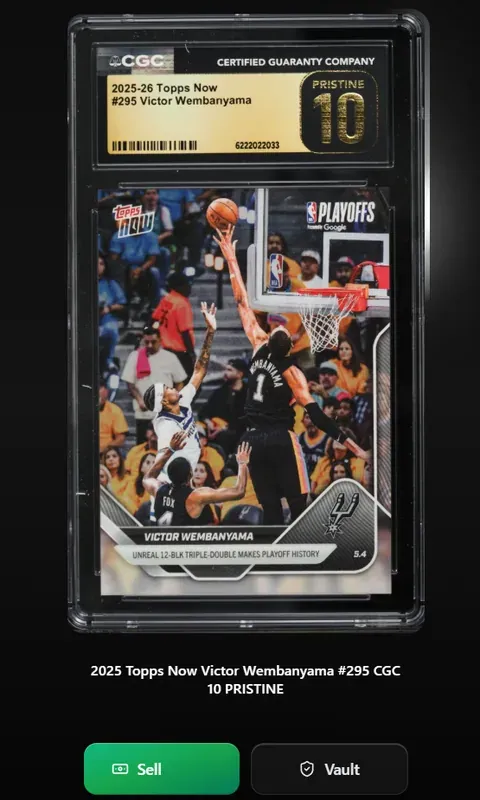
At CGC Cards, a Pristine 10 is the top grade: a card that is virtually flawless to the naked eye, with 50/50 centering and flawless color and registration, and it comes with a label of its own (gold, in CGC’s 2023 announcement). A Gem Mint 10 is also a 10, but one of its grading criteria falls short of Pristine, and it allows centering of about 55/45. Perfect 10 was a third 10, sitting above Pristine at CGC Trading Cards and, from 2022, above Gem Mint at CSG. CGC Cards retired it when those two companies merged in 2023, though cards already graded Perfect 10 keep the grade.
How do Pristine 10 and Gem Mint 10 differ?
| Area | Pristine 10 | Gem Mint 10 |
|---|---|---|
| Centering, front | 50/50 | Not past about 55/45 |
| Corners | Covered by the virtually flawless standard | Perfect to the naked eye, and at the Mint+ grade under 10-times magnification |
| Surface and color | Flawless color and registration | No print spots, perfect gloss, no surface flaws |
| Label | A special gold Pristine 10 label, which CGC announced in 2023 | The standard label |
On the back, Gem Mint centering is not past 75/25. At 9.5 (Mint+), exceptional centering, a strong surface or strong color can lift a Mint 9 card, and the label is the standard one.
Two things stand out. First, CGC’s scale applies these 10s to TCG, sports and non-sports cards alike. From 9 down, some of its centering figures apply only to sports and non-sports cards, but the two 10s carry no such split. Second, CGC words the Pristine standard two ways. The scale says virtually flawless to the naked eye, while its label line says the Pristine label is kept for cards flawless under 10-times magnification.
What does 55/45 look like on a card?
Centering is written as a split of the two opposite borders. Take a card whose left and right borders add up to 6 mm, a round figure picked for the example. At 50/50, each border is 3 mm. At 55/45, the wider border can be 3.3 mm and the narrower 2.7 mm, a 0.6 mm difference. That 0.6 mm is roughly the whole range between a Pristine split and the Gem Mint limit. The figures are Rip.fan’s arithmetic.
AI helps CGC’s graders with time-consuming steps such as measuring centering. To check your own card, the centering checker takes border measurements and shows the split and which CGC and SGC grades allow it. Our checklist before grading covers corners, edges and surface.
What was the Perfect 10?
Perfect 10 came from the two companies that became CGC Cards: CGC Trading Cards, for TCG cards, and CSG, for sports cards. Each used the name, but on top of a different base grade.
| Date | What changed |
|---|---|
| July 2020 | CGC Trading Cards launches |
| January 14, 2022 | CGC Trading Cards describes its Perfect 10 as a Pristine 10 with all four subgrades (centering, surface, corners and edges) at 10 and no flaw from after the card was made, even under 10-times magnification, and starts printing those subgrades on every Perfect 10 |
| March 25, 2022 | CSG replaces its Pristine 10 with Gem Mint 10, makes 9.5 (Mint+) the next grade down, keeps Perfect 10 for flawless cards, and drops subgrades except on Perfect 10s; its green label gives way to black, silver and gold |
| May 12, 2022 | CSG launches a gold Perfect 10 label, for a Gem Mint 10 with all four criteria at 10 and no flaws under 10-times magnification |
| June 20, 2023 | CGC announces that the two companies will combine as CGC Cards in July, with Pristine 10 on top, a new gold Pristine label, and no more Perfect 10s |
So a CGC Trading Cards Perfect 10 was a perfect Pristine 10, while a CSG Perfect 10 from May 2022 on was a perfect Gem Mint 10, because CSG’s scale then had no Pristine grade. Both companies called the result a “quad 10.”
Why did CGC drop it?
CGC seldom used the Perfect 10. In its surveys and focus groups, most people said three 10s (Perfect, Pristine and Gem Mint) were too many. It kept Pristine 10 as the top grade because it had certified far more Pristine 10s than Perfect 10s.
What happens to a Perfect 10 now?
In CGC’s legacy key it is a retired grade that keeps its Perfect 10 status. CGC’s online tools still support it, and the card stays covered by CGC’s guarantee. A Perfect 10 sent in for a new holder comes back as a Pristine 10, and CGC recommends against doing that. Our guide to reading a CGC label covers the rest of the legacy key, including the Gem Mint 9.5s that CGC now counts as 10s.
What about an old CSG Pristine 10?
Here the names can mislead. Before March 25, 2022, CSG had its own Pristine 10, and that month CSG replaced it with Gem Mint 10, the name other sports graders use. So a green-label CSG Pristine 10 sat in the place CSG’s Gem Mint 10 later took, below CSG’s Perfect 10. The name matches CGC Cards’ top grade, but the rank does not.
CGC’s legacy key lists CGC Trading Cards and CSG Gem Mint 9.5s and both companies’ Perfect 10s, but not an old CSG Pristine 10 or a CSG 9.5 (Mint+). Every card graded by CGC Trading Cards and CSG can be looked up in CGC’s Verify tool, so check the cert number there to see how CGC shows the card today.
How do SGC and TAG set their top grade?
Both have a Pristine grade above Gem Mint, but the limits are not identical, so the same name does not mean the same limits at each company.
| Area | CGC Pristine 10 | SGC 10 PRI | TAG Pristine 10 |
|---|---|---|---|
| Front centering | 50/50 | 50/50 | Generally no single measurement past 51/49 |
| Condition | Virtually flawless to the naked eye; flawless under 10-times magnification for the label | Called virtually flawless, with sharp corners on all four sides, no wear visible under magnification, and no print or refractor lines | Virtually flawless, with any issue seen only lightly under high-resolution images and magnification |
| Gem Mint centering | About 55/45 front, 75/25 back | 55/45 or better | For a bordered card, generally no single measurement past 55/45 |
TAG’s Pristine 10 back centering is generally 54.5/45.5 for sports and other non-TCG cards and 52/48 for TCG cards.
SGC’s grade descriptions are guidelines, and other factors can affect a grade. TAG’s report summary rounds centering, so a card measured at 55.05/44.95 can show as 55/45 yet miss Gem Mint. In the 6 mm example above, TAG’s 51/49 would allow 3.06 mm against 2.94 mm, a gap of 0.12 mm, by Rip.fan’s arithmetic. Our guides to CGC and SGC and to TAG grading cover each company’s fees and waits.
What should you do with this?
- Read the label’s grade name, not just the number. A 10 on a CGC Cards label is either Pristine or Gem Mint, and Pristine has a label of its own (gold, in CGC’s 2023 announcement). Older slabs may say Perfect 10.
- Check older slabs in CGC’s Verify tool. A Gem Mint 9.5 shows online as a Gem Mint 10, and a green-label CSG grade may not match today’s grade names.
- Measure before you send. Centering is the easiest Pristine limit to measure at home, with a ruler or a scan and the centering checker.
- Compare like with like. When you look up what a graded card sold for, match the grader and the exact grade name, as our guide to finding sold prices explains.
The glossary defines the grading scale, centering, subgrades and CGC, and our guide to card condition covers the raw grades below these.
Frequently asked questions
Does a TAG Pristine 10 come with a TAG Score?
Yes. Every card that reaches TAG Pristine 10 gets TAG's full scoring, the 1,000-point TAG Score, even when it was sent at a service level that leaves the score out.
Does a card keep its subgrades in a new CGC holder?
No. At CGC Cards, a card with subgrades loses them when it is reholdered. The old CGC Trading Cards and CSG labels are no longer offered for a new holder either.
Why does CGC call a Gem Mint card a 10?
In a 2023 survey a third party ran for CGC's parent company, 79% of card collectors and dealers equated Gem Mint with a 10. CGC Cards treats a Gem Mint 9.5 as exactly equal to a Gem Mint 10, with no action needed from the owner.
Can an autograph get a 10 at CGC?
Yes. CGC Cards grades an autograph on its own 5 to 10 scale with no half grades. A signature that falls below 5 gets the Authentic designation instead of a number.
Can you dispute a TAG grade?
As a rule, no: TAG generally does not accept cards for grade disputes. A card graded 9 or lower whose report lists no defect may be a data issue, which TAG looks at when the owner emails the order and cert numbers.