How to tell if a Magic card is fake
Compare a Magic card with a genuine one from the same set, then check its rosette dots, black ink, back, hologram and stock. Skip tests that damage cards.
By the Rip.fan Editorial Team.
Published 8 min read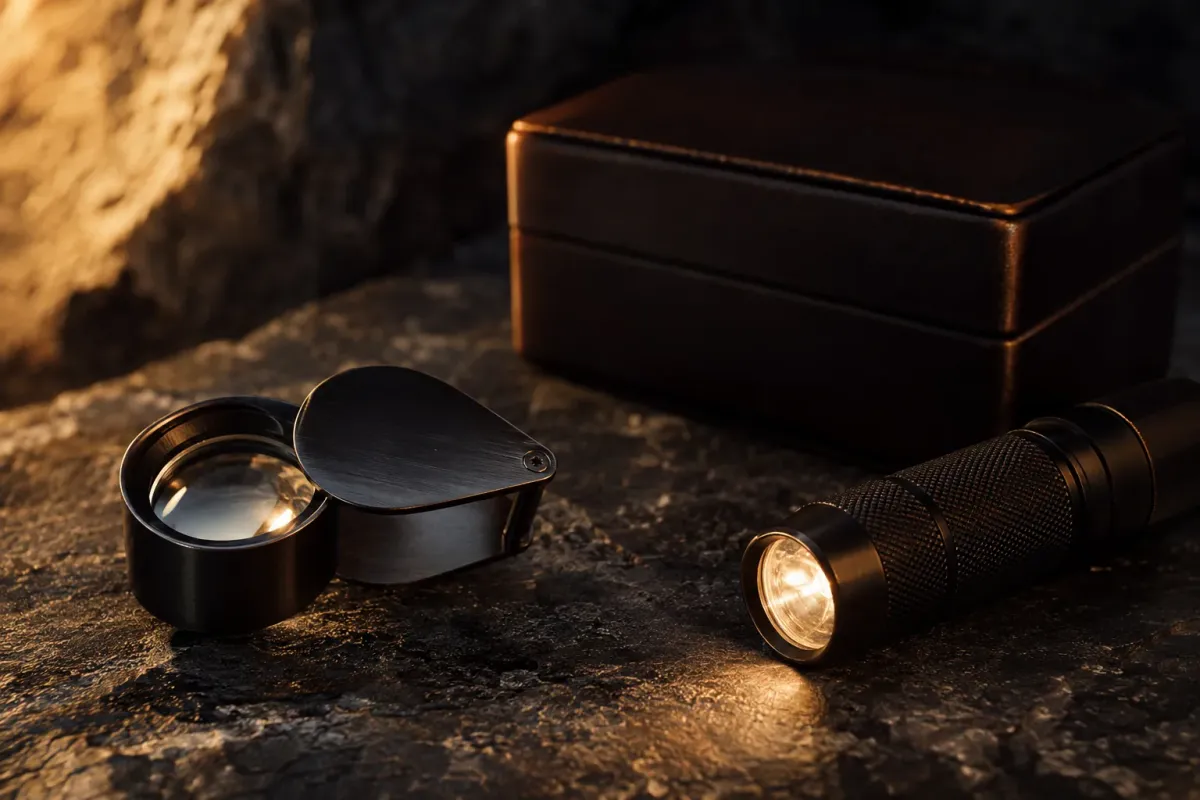
The surest way to tell if a Magic: The Gathering card is fake is to set it beside a genuine copy, or a genuine card from the same set, and compare. Then look closer. A jeweler’s loupe shows whether the printed dots form the rosette pattern of a real card and whether the black text is solid. The back should pass the green dot check, and the stock should flex like a real card. TCGplayer said in 2021 that rares and mythics from mid-2014 on carry a hologram, which is hard to forge. The light test, which Wizards described in 2004, is one TCGplayer says not to rely on, and several tests you will find online damage the card. Wizards of the Coast does not verify cards for anyone.
What does Wizards of the Coast say?
Three Wizards pages bear on fakes, and they are of very different ages:
- Its support page on counterfeit cards, updated July 7, 2026, sends readers to an older article for the checks. It says Wizards does not replace counterfeit cards and has no card verification service. You can mail suspected fakes to its Production Analysis team, but you will not hear back about them and the cards are not returned.
- Its page on buying genuine product, updated July 28, 2026, is about sealed product. It says a booster box should be sealed in plastic and carry a Wizards stamp, that vertical heat striations on a pack’s seal show the pack has not been opened, and that the dealer should be a reputable one. For online buying in North America, it names the Authorized Internet Retailer logo, which marks stores approved to sell sealed product, and it adds that proxy copies of valuable cards are not originals.
- Buyer Beware, a feature published April 26, 2004, is the checklist the support page sends readers to. It is more than 20 years old, so read its card checks with that date in mind.
Which checks should you do first?
These checks do no harm. They run roughly from the quickest to the closest look, and each names its source, because the sources do not all agree.
| Check | What to do | What a genuine card shows | Source |
|---|---|---|---|
| Side by side | Compare with the same card, or a card from the same set with a similar color, rarity and finish | The same size, font, letter spacing, texture and shine | TCGplayer, 2021 |
| Rosette pattern | Look at a colored area through a jeweler’s loupe | Tiny dots in a flower-like rosette that matches other cards from the set | TCGplayer, 2021; CGC, 2023 |
| Black ink on older cards | Look at the card name and mana symbol through the loupe | Solid black with a sharp edge, because black was printed last, over the colors | TCGplayer, 2021 |
| The back | Check the green dot and the words on the back | Four red dots forming an L inside the green dot’s shine, and a slight wave in the T of “The” | CGC, 2023 and 2024 |
| Hologram | On rares and mythics from Core Set 2015 (July 2014) on, look below the text box | An oval hologram at the bottom center; TCGplayer says faked ones usually look damaged up close | TCGplayer, 2021 |
| Stock and flex | Press gently with a thumb, then do the same to a basic land from the same set | The card gives and springs back the same way | TCGplayer, 2021 |
| Weight | Compare by hand with genuine cards | A fairly consistent weight; a card that feels noticeably lighter or heavier is a warning | TCGplayer, 2021 |
TCGplayer’s reasoning on the rosette check is simple: it says all the cards in a set are printed on identical printers, so rosettes that do not match another card from the set mean a fake. It also cautions that none of its tests is conclusive alone, because some fakes pass one or more of them and some real cards have printing quirks that look wrong, so apply several. It put the price of an effective loupe at about $20 in 2021. Wizards’ 2004 article said much the same of magnified dot patterns. It called the word Magic on the back, where black meets red, one of the best places to check print quality, and said many fakes show black edges with gaps or bleeding into other colors.
CGC’s fake Black Lotus, reported October 5, 2023, failed on these lines. The rosette pattern in the lotus was wrong, the text was blurry and slightly bolder than it should be, and the card felt more papery than standard Magic stock.
How reliable is the light test?
The two sources, 17 years apart, weigh it differently:
- Wizards, 2004: Magic cards other than foils let some light through when held up to a bright light. Hold a known genuine card and the suspect card at the same distance and compare. Fakes often let no light through, and almost always differ in a way you can see.
- TCGplayer, 2021: a phone light behind a real card shows through with a blue tint from the glue layer in the middle of every Magic card, and a card that blocks the light is almost certainly fake. But many fakes now pass, so TCGplayer says to know the test and not rely on it.
The rule that follows: a card that fails the light test is a strong warning, and a card that passes has proved nothing. Use it on non-foil cards only.
Which tests damage the card?
Several tests change the card, and the two sources split on them too.
| Test | Wizards, 2004 | TCGplayer, 2021 |
|---|---|---|
| Bend test | Described as a test only for a card you can afford to damage, never for foils; a real card typically creases slightly around the eighth fold, and most fail by the twelfth | Not recommended, because any card creases if bent enough times |
| Water test | Described as a test only for a card you can afford to damage, not for foils: a damp paper towel along the border can make some fakes bleed | Not covered |
| Tear test | To be used sparingly, since it destroys the card: a real card shows a blue or black line where it tears | Not recommended |
| Blacklight | Not covered | Not recommended: a loupe gives better information and fewer false alarms |
A creased, damp or torn genuine card loses condition, so leave these to a grader. CGC’s graders use UV and infrared light, close microscope inspection and non-destructive ink and paper analysis. On the fake Black Lotus, the inks looked much darker than a genuine card’s under infrared light. Under UV light, the text box’s background pattern, which mostly disappears on a real card, stayed clearly visible.
What do altered older cards look like?
Not every fake is a full reprint. Some are genuine cards changed to pass as pricier ones:
- Inked borders. Wizards’ 2004 article describes white-bordered cards from sets such as Revised, Unlimited and Chronicles with the white edge filled in with black marker to pass as an older, black-bordered printing. CGC will not grade a card altered to look like a rarer version, such as white borders turned black or a changed set symbol.
- Rebacked cards. Most are made from two cheaper cards, sanded and glued together, one supplying the face and the other the back, to forge an expensive card. CGC will not grade them. Wizards’ 2004 article described a similar pasted card, often given away by a heavily worn front on a nearly new back.
- Clipped corners. CGC will not grade Beta cards whose corners were made rounder to imitate Alpha. Wizards’ article also described square-cornered Collector’s Edition cards trimmed and painted to pass as Beta.
Our guide to spotting an altered card covers these checks in more detail.
Can a graded Magic card be fake?
Yes. On February 7, 2024, CGC reported that a Legends Mana Drain sent to it for crossover, the service for cards already sealed in another company’s slab, was a fake. Its colors did not match genuine cards from the set, its surface was much glossier, it failed the green dot check, the T on its back lacked the wave, and its wear looked forced.
A second CGC case shows the limits of the back check. In December 2023, CGC caught a fake Pokémon Test Print Blastoise that had been printed on a genuine Magic back. Because the back was real, it passed the green dot check, and the front gave it away. A back check proves only the back.
So check the card in the slab as well as the slab, and look up the cert on the grader’s own site. CGC does not certify counterfeits, which it defines as cards made by anyone other than the official company, and it returns a card that appears counterfeit as Questionable Authenticity, still charging the grading fee. Our guides to spotting a fake slab and grading Magic, Yu-Gi-Oh! and One Piece cards cover the next steps.
How do you check sealed Magic product?
Wizards’ 2004 article said its boxes came in plastic overwrap printed with white Wizards logos, and that no counterfeit it knew of had copied them. On genuine packs the heat seal striations ran vertically, while the counterfeit packs it found had far fewer, mostly horizontal ones, and bent much more easily when pressed at the ends. It also warned about old boxes, such as Arabian Nights or Legends, refilled with recent cards and rewrapped. Wizards’ 2026 buying page still lists vertical striations and adds the Wizards stamp on sealed boxes. The glossary covers sealed product and the resealed pack, and our guide to Collector Boosters covers what a genuine pack holds.
What if you already bought a fake?
Wizards will not replace it. If you bought it through TCGplayer, report a suspected counterfeit within 30 calendar days of the order’s estimated delivery date. TCGplayer sends a prepaid label, its team tests the card, and the card must reach TCGplayer before a refund. Research pricey cards first, including how printings differ, and ask why when cards come in bulk at a big discount.
Our guide to avoiding card scams online covers other platforms, and checking Magic card prices shows what a card normally sells for. The Magic, Yu-Gi-Oh!, One Piece and Lorcana hub and the counterfeit card glossary entry have more.
Frequently asked questions
How can you tell a white-bordered card inked black?
Look at the frame and the small print. In 2004, Wizards named two giveaways on a Revised, Unlimited or Chronicles card inked to look black-bordered: no beveled edge where the card frame meets the border, and the copyright dates in the legal text.
Are square-cornered Magic test cards genuine?
Some are genuine cards that were never released. In 2004, Wizards said cards with square corners and white or black borders, print tests among them, had been stolen from it and its printers over the years, and that many dealers refuse to buy or sell them.
Where should you report a counterfeit Magic card?
To your local law enforcement agency, the Internet Fraud Complaint Center or, for an online purchase, the Federal Trade Commission. Wizards also asks for any facts about who made or sold the fakes, such as a name, address or email.
Does eBay check Magic cards for fakes?
On listings with its Authenticity Guarantee badge, yes. In the US that covers single collectible card game cards at $200 and up: the seller ships the card to PSA, which inspects it before it goes on to the buyer.